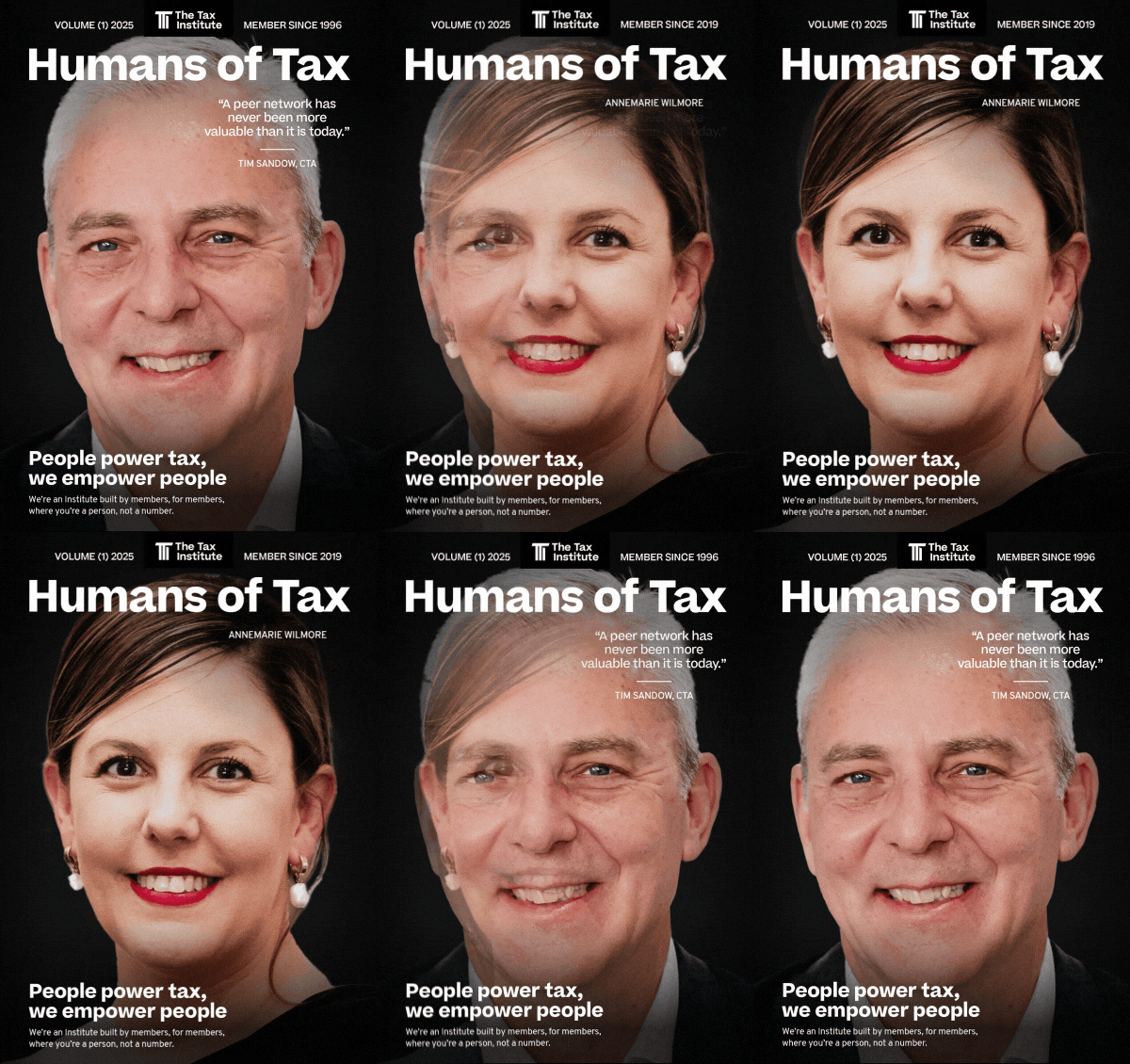
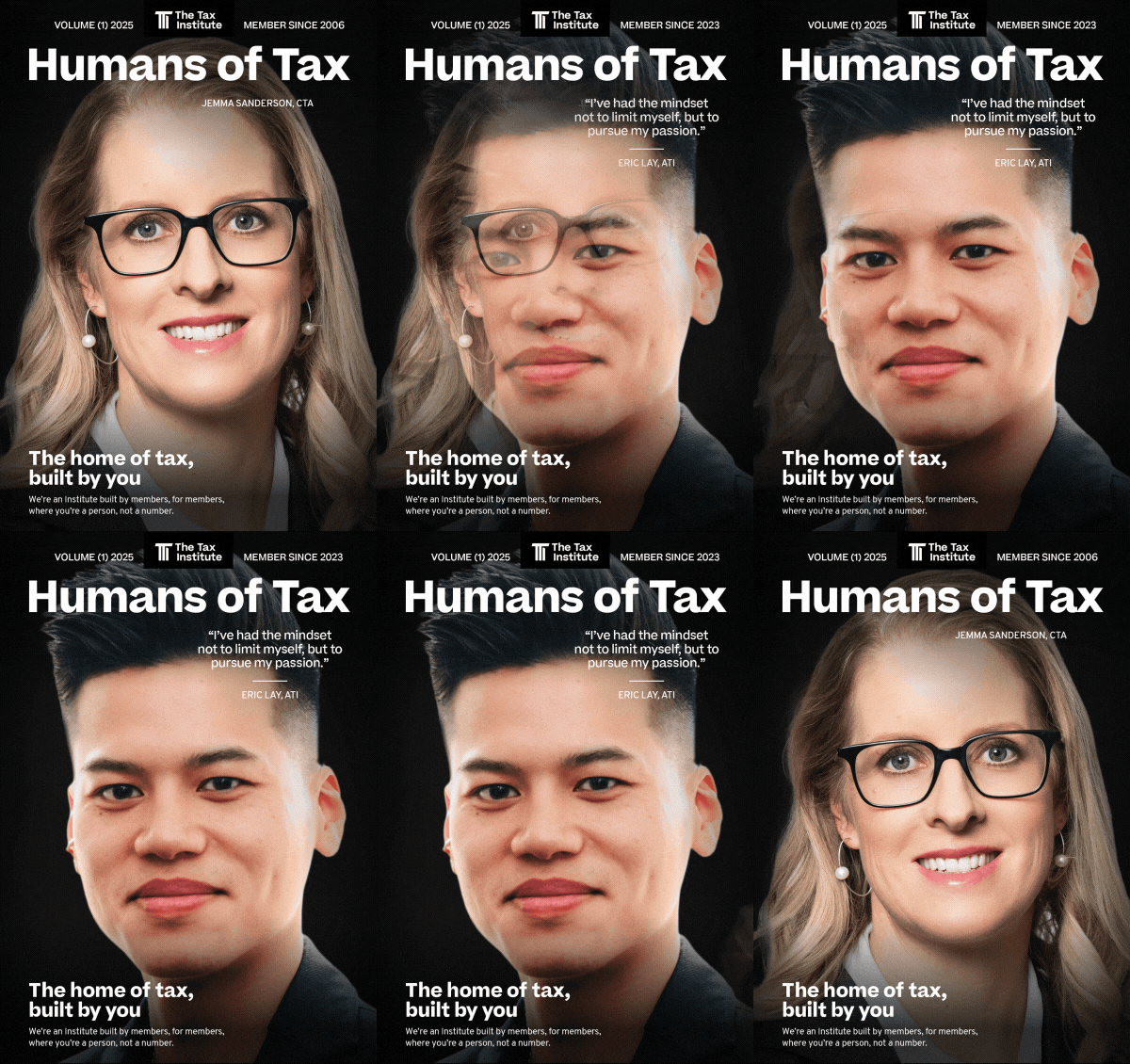
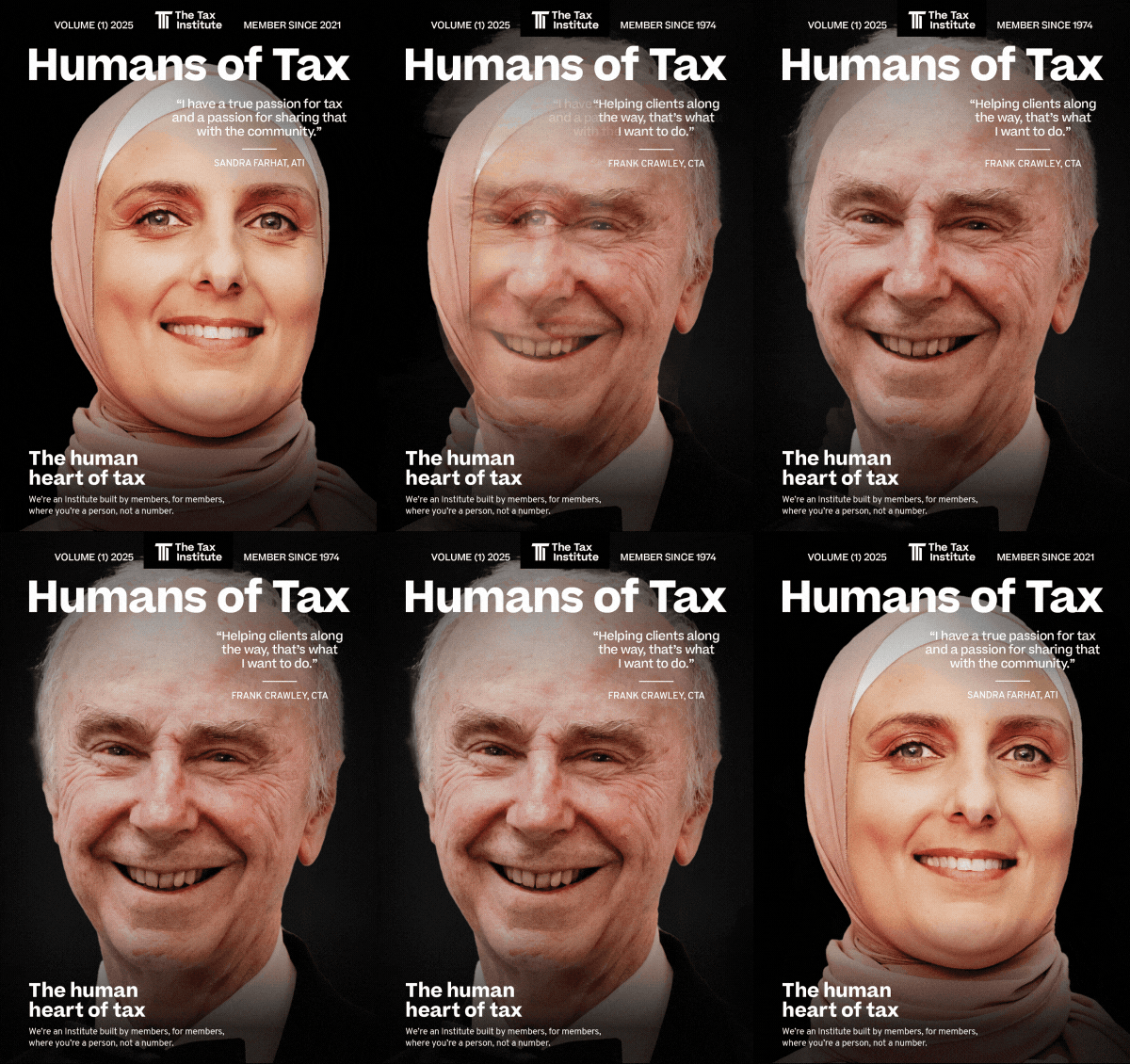
The human heart of tax
We're for members, by members.
These are the people who make our community what it is — the Humans of Tax.
Read their stories here.

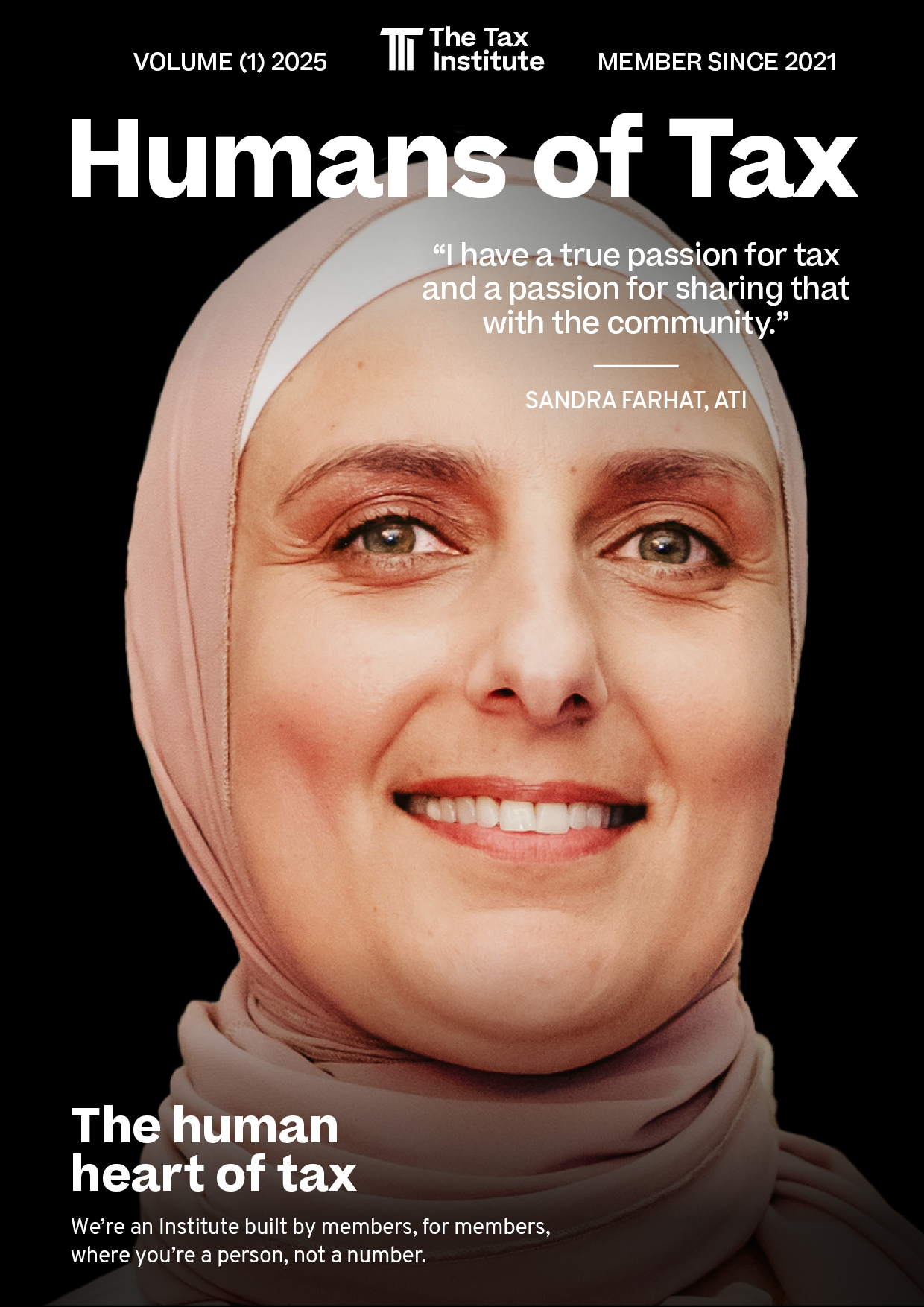
Sandra Farhat, FTI
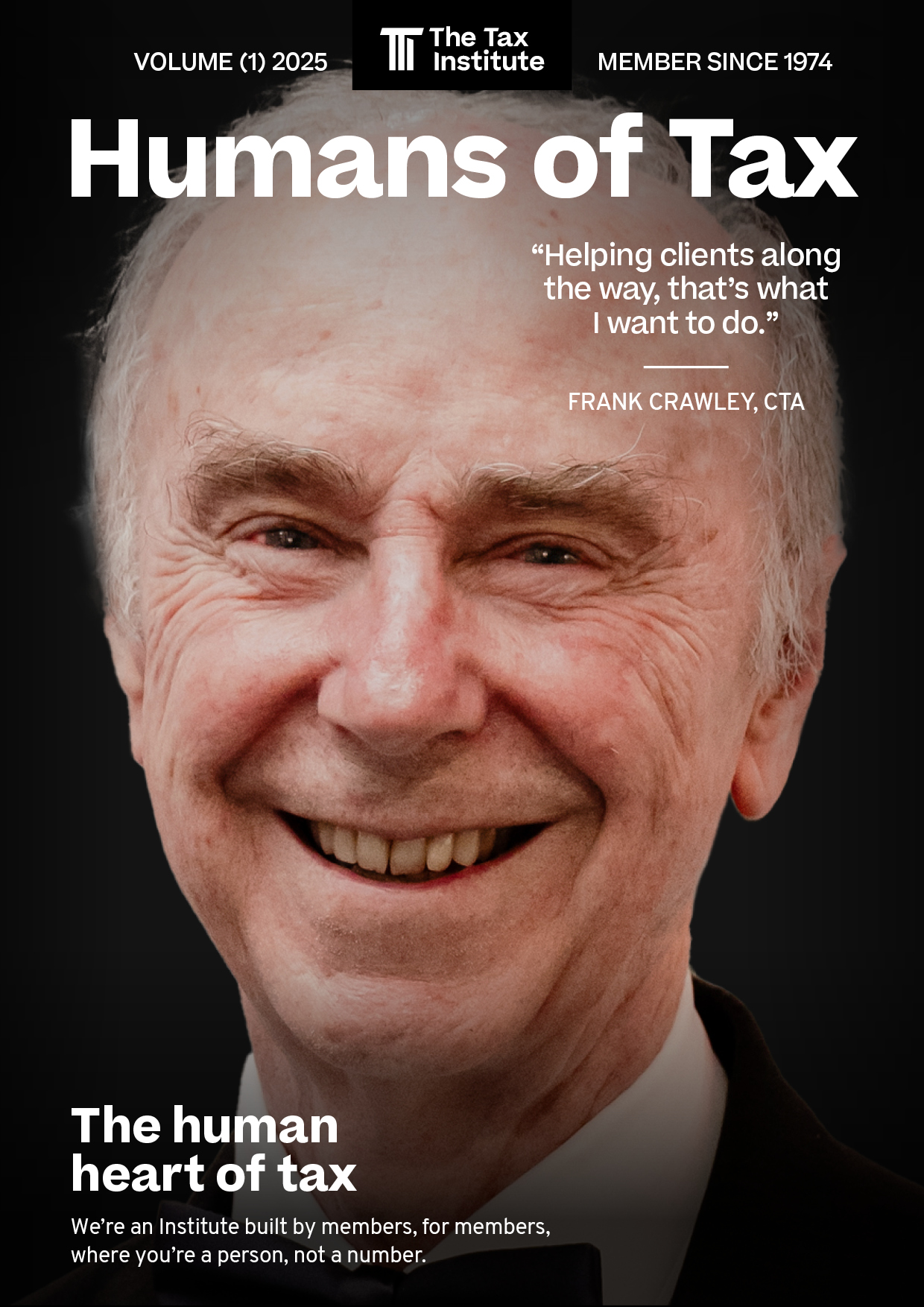
Frank Crawley OAM
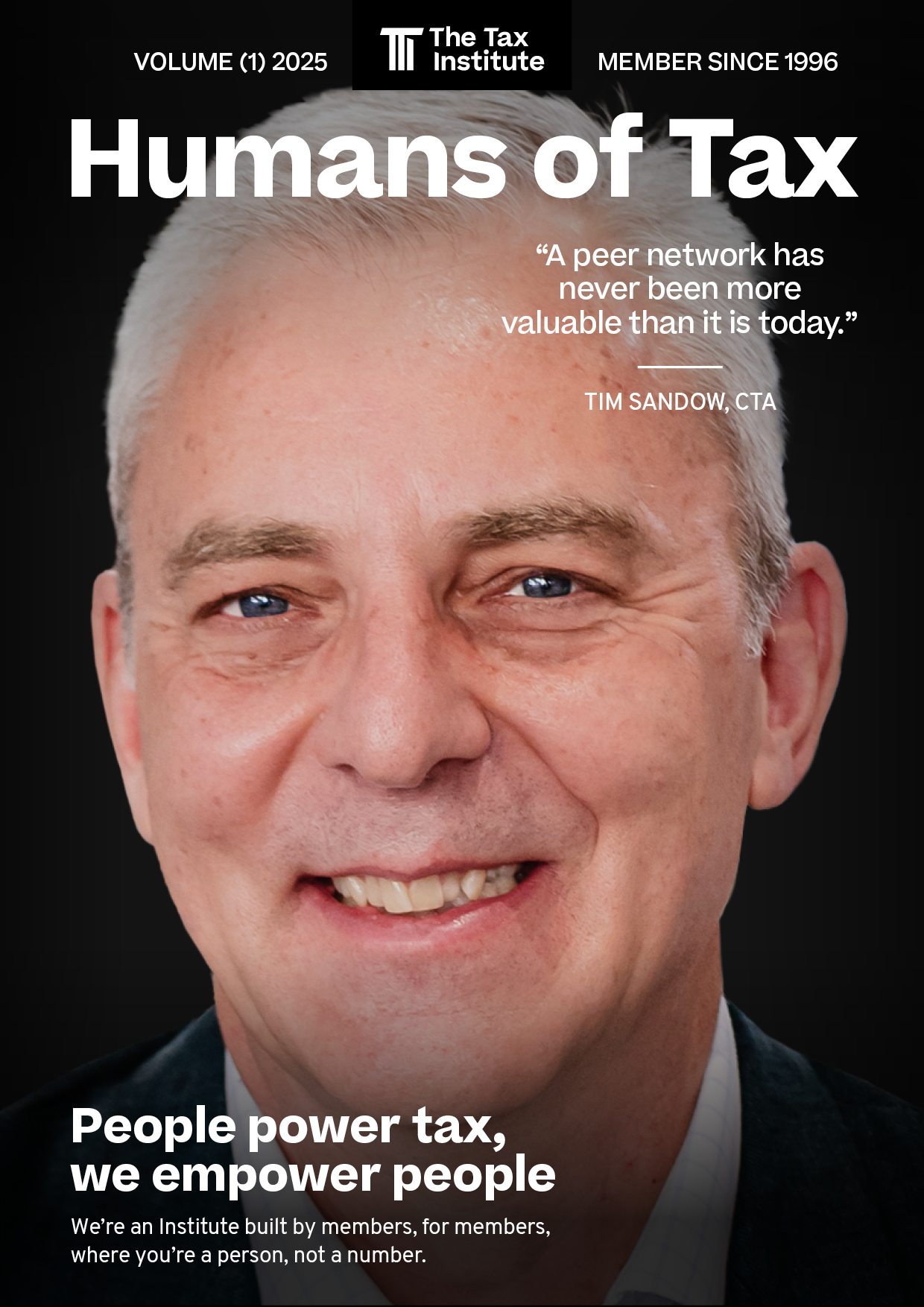
Tim Sandow, CTA
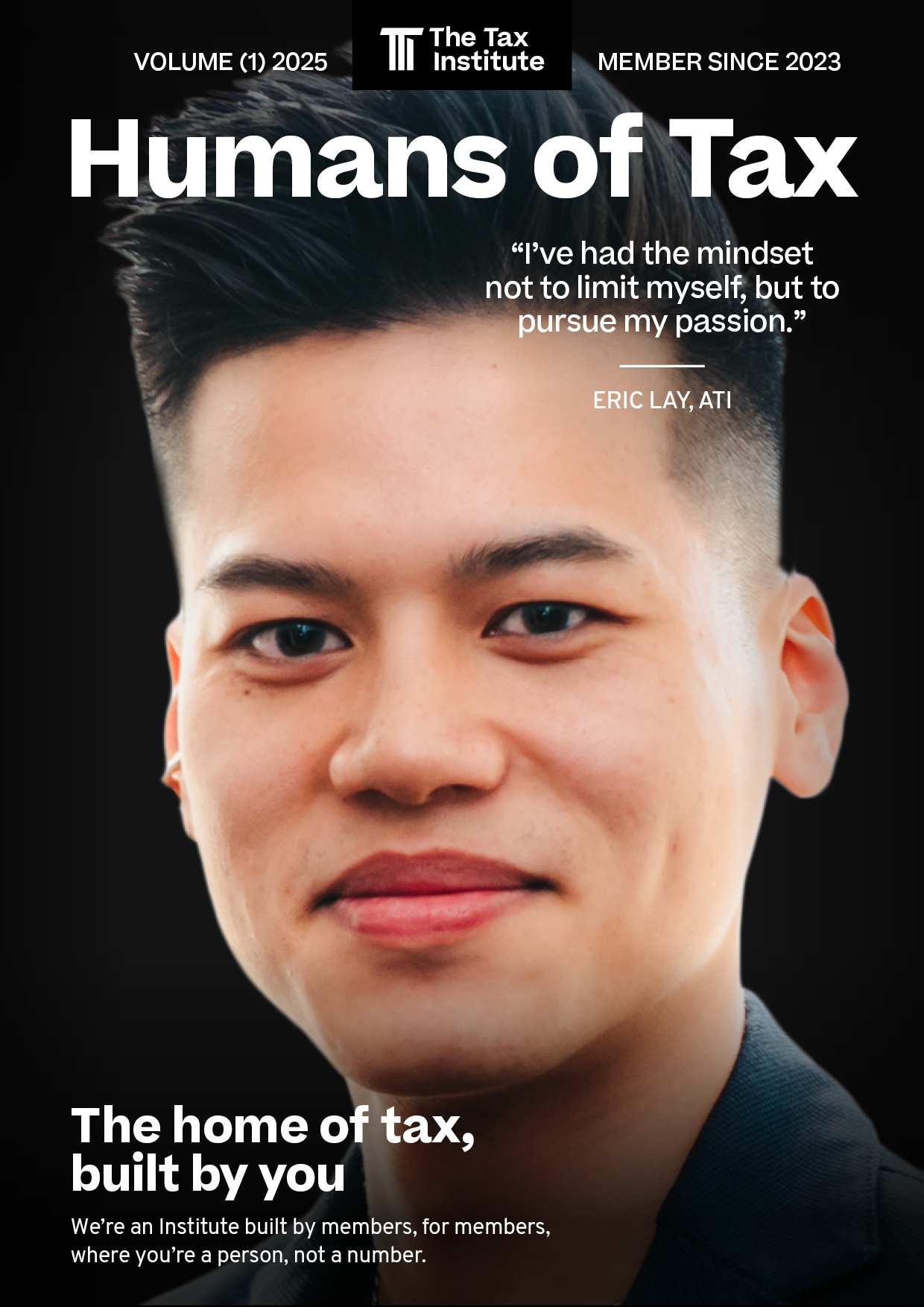
Eric Lay, ATI
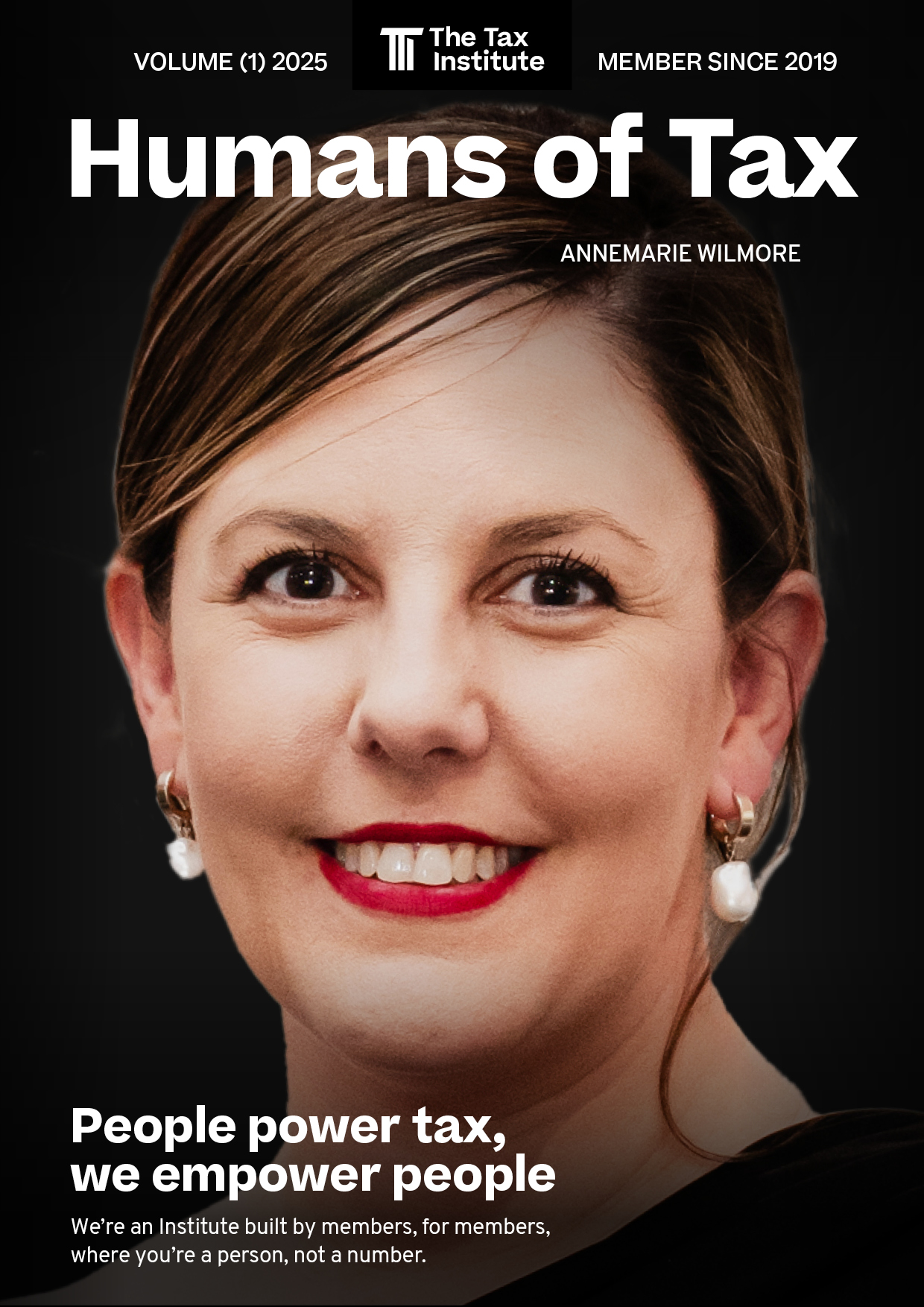
Annemarie Wilmore, CTA
Featured story
Daniel Butler: SMSFs, surfing and simplicity
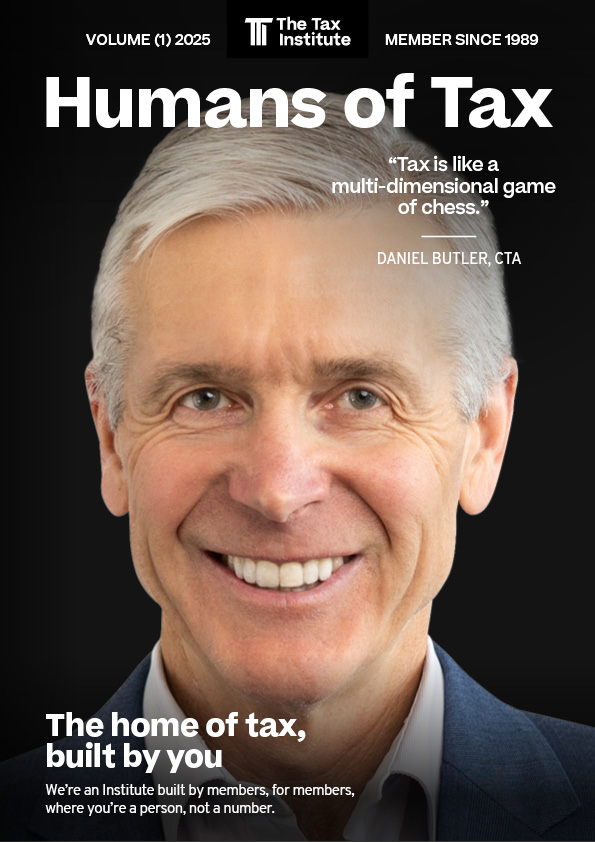
Daniel Butler, CTA, is the Director of DBA Lawyers in Melbourne, and a member of the Institute for 36 years.
Daniel sat down with us to chat about his tax career of over 40 years, changes in the superannuation sector and how his surfing hobby reflects the challenges of a tax career.
So, Daniel, last time you chatted with our team, you revealed that you like to surf. Are you still a surfer?
Oh, yes, I was surfing on the weekend. My children surf too and we enjoy spending quality time together on surfing trips or getting a surf in on weekends.
It's good for your mental resilience. When you're in the ocean and the waves are coming at you, you’re dealing with the wind, the tide, the waves – there are a lot of things conspiring against you. So, it's a real mental challenge as well.
Does this idea of putting yourself in challenging situations reflect your approach to your work as well?
It does. Tax is like a multidimensional game of chess and you have to have your wits about you. You don't know what to expect – you have to expect the unexpected. It's a mental challenge, just like surfing.
My pursuits of surfing, and cycling too, is also about relaxing. It really allows you to get out and just come back to basics.
Are you ever thinking about complex tax issues while you're out in the surf, or is it a moment without work?
It's a bit of both. I commute to work most days by cycling along the beach. I have this wonderful Vista and it's quite relaxing. It's unlike being in a car. It's amazing – my mind's at peace.
I don't have the pressure. It's getting the endorphins going. Your mind is conjugating over things and I’m often I'm solving very complex problems. You're free. It's very helpful.
Ok, so let’s talk a bit more about your work. You are the go-to guy for SMSFs.
Well, that's humbling to hear. I won't deny it.
Can you tell me a bit about how you got involved in that particular area of tax?
Initially, I started my career in a large international chartered accounting firm, one of the big eight in the early 1980s. I've always considered myself a tax adviser or a tax lawyer, but I saw the need to have a specialisation.
I chose superannuation and I was previously dealing with both large and small funds. As time evolved I could just see the niche opening up for SMSFs. I really wanted to focus on that niche because they were very interesting. There was a lot happening then, and the SMSF industry has grown rapidly over the past 20 or so years.
You need to be familiar with tax concepts to provide SMSF advice, so super and tax suited me.
You say that you saw that niche opening up. What were the signs that this was the next big thing in tax?
In 1986 we had the occupational Superannuation Standards Act 1987 (Cth), so there was a major change. Then fast forward, in 1993, we had the Superannuation Industry (Supervision) Act 1993 (Cth).
Around that time there was major worldwide fear around super. The Robert Maxwell scandal had just broken in the UK. He had plundered millions of pounds of many thousands of employees pension funds to prop up his ailing businesses which included the Mirror Newspaper Group.
In November 1991 Robert was found floating dead in the ocean near his luxury yacht with speculation there may have been foul play or he may have taken his own life. There was even the joke that circulated after this scandal that, “while this was a lot of money to the thousands of poor pensioners, it was a mere drop in the ocean to Robert Maxwell”.
That sent shock waves around the world. The UK and many other Governments tightened up their pension and superannuation laws considerably.
And that’s about the time you started your own firm, DBA Lawyers, right?
It was an opportune time to set up DBA Lawyers. Ever since the Superannuation Industry (Supervision) Act 1993 (Cth) was introduced, legislation, case law and practice and procedure in super, especially the SMSF area, has flourished and continued to evolve and become more complex.
I was working for a major international law firm in Sydney in the early 1990s. I did enjoy my time there, but I didn't see myself dealing with so many other partners long-term.
" My goal was having a smaller business that I had more control over, where I could be a specialist in certain areas and provide very good service and support.
I was hoping back then that I could have taken a 6- or 12-month period to have a break and to catch up on some of my other pursuits. Back then I was still into yachting, surfing and cycling, although back then my surfing was primarily windsurfing.
Starting up DBA lawyers was a challenge at the right time.
Never looked back?
Never looked back. It's interesting coming from a large international accounting and law firm background dealing with international tax and major $300M deals, etc, to dealing with smaller matters in terms of dollar figures, but still very technically complex and challenging matters with far more direct contact with the decision makers.
You’re working with families, you're working with owners of businesses. It was quite satisfying to get that direct link with clients that would really appreciate what you're doing. I've never had issues with the work that I've done; I’ve never been bored but always feel that I’m learning and growing my skill base.
You were also one of the first lawyers in Australia to design an SMSF deed for small funds small funds with only a handful of people.
Back in those days around 1990, I was continually seeing superfund deeds with all sorts of provisions which depended on a certain number of employees. For example, there were special rules back then if the fund had more than 50 members and there were also special provisions for funds with more than 300 members.
Typically, a lot of deeds for small funds had everything in them, including the kitchen sink. It had all this clutter of provisions that would never apply, because self managed super funds had to have less than 5 members at the time (now a maximum of 6).
So, I just cut out all the clutter. It reduced the deed so much and made it far more simple.
I believe that I was the first lawyer to prepare an SMSF deed specific to the needs of an SMSF. We have also designed our deed with considerable thought and careful drafting over many years.
That’s the goal, isn't it? To make things simple accessible so people can understand what they're doing.
Yes. And I think we’re still today known as having the best SMSF deed in the country.
I have no doubt. If you cast your mind to the future, are there signs of the next big thing, do you think?
Well, we are about to see a tax on unrealised gains, with Division 296.
So there are these adverse impacts of taxing unrealised gains.
Capital Gains Tax was introduced in 1985. Fast forward 40 years to 2025 and we are now wanting to tax unrealised gains. We're taxing blue sky. The trouble with taxing blue sky is that they tax you the upside, but don’t give you a deduction or refund if you lose.
So, if you lose, you're on your own. The only thing that we do get is a carried forward loss that is quarantined against a future upside of your super going up.
The danger with that is that a lot of people will never get the opportunity to capture that upside. They've paid the tax on the way up and let's say their investments decrease substantially or they're ripped off by a scammer. Bad luck. It's very inequitable, very unfair.
My view is that we should not tax unrealised gains, but if unrealised gains are to be taxed, I believe as a matter of tax symetary, any unrealised loss should be treated as a tax deduction and offset the individual’s other taxable income. If that person does not have any taxable income, then a refund should be made.
The bigger picture is that the self-managed super fund industry is going strong and there's over $1 trillion in the system. It's about 25% of our super savings in this country. They still have a good place to sit in our positioning of a tax advantaged vehicle, but there's going to be a much bigger cap on what people will be able to accumulate in a super fund moving forward. We expect a considerable transfer of assets from SMSFs as a result of division 296 with members withdrawing their super to invest or spend elsewhere.
What are your views on formal education, things like university or structured courses and on-the-job upskilling when it comes to a tax career?
I am a big supporter of both. Not one, not the other, both.
I find that core education, like doing a course of study with a university or The Tax Institute, is very important, as there's a lot of change in tax. The pace of change and pressure on advisers today is much greater than I have ever experienced in my past 40+ years of practice. This is disappointing as complexity abounds, and you need experienced and dedicated people in the profession to ensure we have a well-functioning tax and super system. However, there are rewards for those who go the extra distance and keep up to date, or, as up to date, as possible. Otherwise, you fall far behind.
I've always dug into the detail of changes in tax law, so I can advise clients there and then on what's happening. My aim is to be a thought leader, to be at the cutting edge and be ahead of the curve in the fields that I practice in. It's lifelong learning, so on the job training is also fantastic. Every question and every assignment allows you to learn more or review what you had previously reviewed and enhance your skills.
However, these days, I feel that with each layer of complexity and continuous change, there is little, if any, opportunity for many advisers to get on top of things and become experts. Instead, many advisers are bogged down with more paperwork and compliance and the regulatory systems do not respond to the needs of our modern world in a timely and flexible manner.
If you could describe in a nutshell what makes a great tax professional, what would it be?
Be passionate and willing to do the hard work, research and learning. And with dedication to lifelong learning you should become a passionate professional.
Eric Lay: building the professional culture you want to see
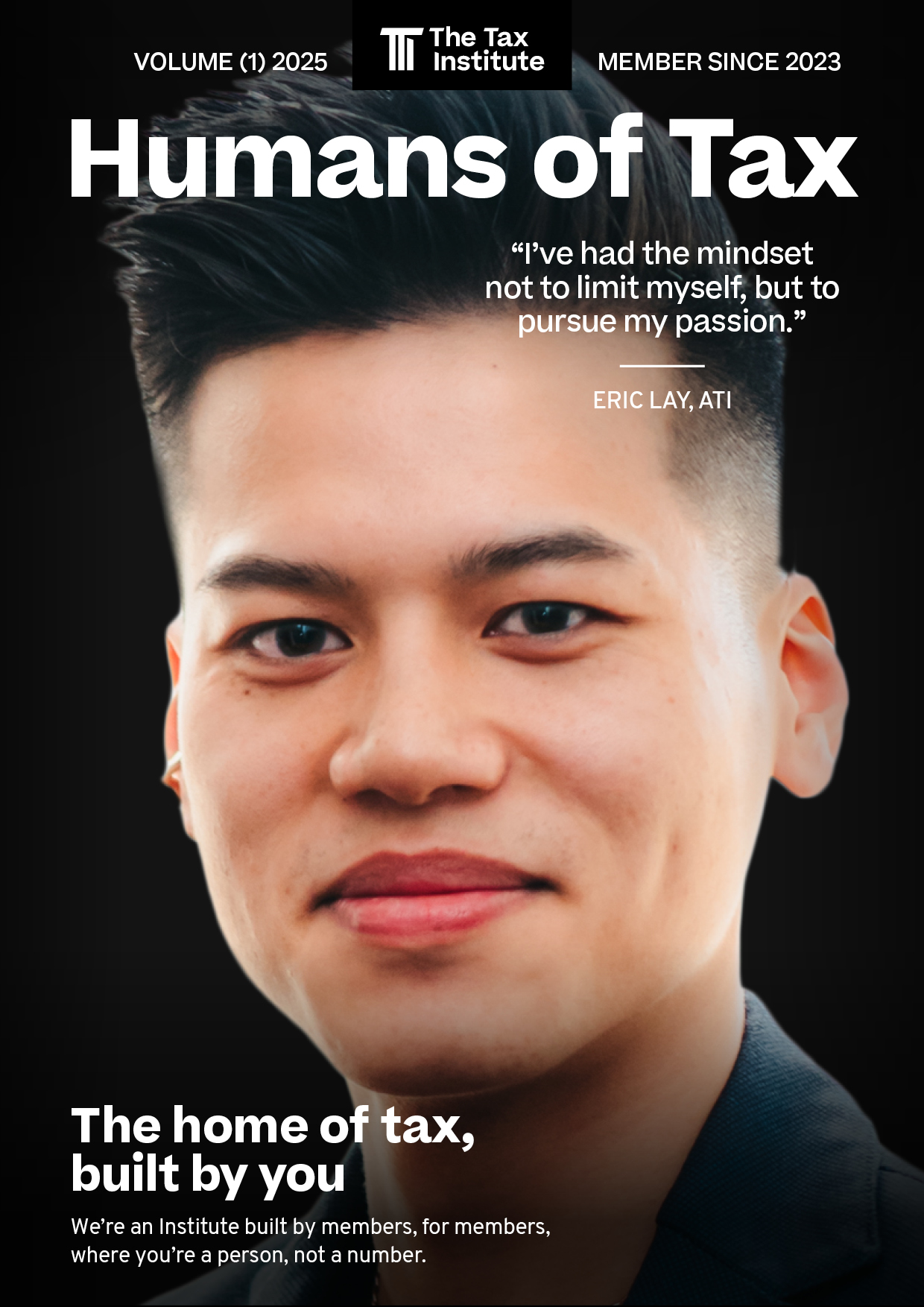
Eric Lay, ATI, Assistant Manager at SW Accountants & Advisors, is a relatively new member of the Institute, joining our community in 2023.
In his own words, Eric shared with us his thoughtful insights into discovering tax despite a focus on law early on, working to encourage diversity and inclusion in the profession and the considerable merits of a workplace Tea Club.
This is your story, Eric. Where do you think we should start?
Well, in my journey, I think the most interesting thing is that I did a straight law degree, so I was never involved in the tax world or even wanting to go into legal practice when I was in law school. I didn't do accounting or commerce. It was only through my professional journey that I fell in love with tax and that's why I'm actively pursuing it.
So, for example, I started off at the ATO in my graduate program because I had a graduate offer during COVID. It was an opportunity that fell in my lap and I thought, “Might as well try something different.”
I went in and fell in love with it. It was such an exciting time to be in tax, to see how you can help people. I think being in the machinery of all of that during this time, when I had never set foot in tax before really cemented a mind frame of, “oh, this is actually not what you think it is. Tax is so much more than just accounting or just complex legislation. It can help people.”
So, you didn’t come directly to tax then?
Tax found me.
I love it. Tell me what it was like being a COVID graduate because that was a crazy time to come into the world of work, let alone the tax profession, right?
Yeah, exactly. When I started the grad program in early 2021, I had one week in the office, and on that Friday they announced Omicron.
I still remember it because I was the “social secretary” of my grad cohort. It was the first week at the ATO office and I organised a dinner at the end of the week to celebrate this great step forward in our career.
And then Omicron got announced while we were at dinner.
Oh no.
Yeah. So, it was a scary time in terms of uncertainty. Obviously, no one knew what to expect. But one thing that was very lucky about the ATO program was that we had a rotation where we did a few weeks in the call centre so we get to talk to taxpayers and understand what their pain points are. During that rotation you come into the office every day. So myself and a whole bunch of the graduates were able to still come into the office together.
We organised a little tea club, because ATO people love their tea breaks. We would bring a different tea each day and then we would share our teas and just catch up. I thought that was just so lovely. It really helped me get through that COVID period.
Alright, very important question. What was your favourite tea?
Oh, it was Rooibos. It's a South African tea. But also, I can't say no to a good Jasmine tea because it gives me throwback to Yum Cha with my family. So, it's between those two I would say.
"I think as long as we can create the environment
where these younger people coming into the profession
can see themselves in leadership roles,
that would be the starting point."
It seems like the social aspect of work is really important to you. What role do you think company culture plays these days?
I think company culture is super important because you spend roughly a third of your life at work, right?
So, if that's the case, you want to spend it in a workplace that fulfils you — that isn't just paying your bills, but actually feels like you're given a purpose or you’re building connections. That’s important for me because I'm a very social person. I'm very extroverted.
For me, it's always important to not only find a workplace that has that culture, but to build upon that culture as well. For example, I recently joined my firm’s inaugural Diversity and Inclusion Committee, because I want to help them on their DEI (Editors note: Diversity, Equity & Inclusion) journey and help them continue to build an inclusive culture at the firm.
I've been on many DEI committees before. At Hall & Wilcox, I was Co-chair of their committee and helped launch the Fitzroy Legal Service Night Clinic for the LGBT community. Before that, I was also in the Committee for ATOMIC, which is the ATO Diversity Committee for the LGBT community, and that was for about 10,000 people across Australia.
So, I've been part of DEI committees in a whole bunch of organisations because having the ability to be your authentic self is so important for me.
The tax profession has a reputation for not being incredibly diverse. Do you think that's a fair reputation? Is it changing?
I think it's definitely changed from a decade ago. It's important to recognise that we’ve all come from a time where most workplaces were less diverse, but that's not what we are now. You see so much diversity now, younger people, more women, more people of different ethnicities joining firms.
When I talk to someone in a non-tax field, I tell them I work in tax and they’re so surprised, like “oh, I never would’ve imagined someone like you would work in tax”. And that’s because tax isn't what you think it is. It's those kinds of small interactions that are slowly helping change the reputation of tax.
Representation and visibility are so important. I think as long as we can create the environment where these younger people coming into the profession can see themselves in leadership roles, that would be the starting point. They can say, “Eric is in this role, and I can hit this pathway too”.
Diversity's obviously important, but it's also difficult thing to change in a short amount of time. Change is a long process, and you don't expect it to happen overnight.
We are all on the journey of change, at different stages. It would be great if people took on the mindset of joining that journey and taking some responsibility for crafting the workplace and culture that you want, as no workplaces come with perfect cultures. That's why I joined my firm’s DEI committee. Even though we're very early on in our journey compared to other more established organisations, I still think it's great to see that they're making progress.
What role has your own background played in your career journey, if any?
Personally, I love that I stand out. I'm obviously of South Asian descent, I'm also part of the LGBT+ community and I didn't do accounting or commerce, I came from a straight law degree with no prior tax background.
I love that I show other people that you don't need to have accounting training. I show that you can be of a different ethnicity, with different lived experiences and still find enjoyment in tax. I love challenging those misnomers about tax just by being in it myself. I think a lot of people can do that themselves as well.
If anything, it also helps contribute to my client work. For example, being of South Asian ethnicity and understanding how people of those cultural backgrounds view taxation. They often don't see the need to have formal agreements and formal loans in place, they might prefer more of an informal nature. Having that background helps me talk to clients and communicate how we actually should document things, or how we should structure things, because these are the Australian rules and this is how we have to comply with our tax system.
Being able to understand where they're coming from gives me an edge in engaging with clients, I think.
"I definitely have tried to maintain a growth mindset throughout my career and I think it's really important that everyone does."
That's really interesting. For someone who lacks that background and they're working with clients who, say, come from a different cultural background, what would be your advice to bridge that gap?
I think your colleagues are your number one resource. Your colleagues have their own lived experiences, their own perspectives and using that community you have is so important. I think some people may not feel that is open to them, because maybe they feel like it'll make them look stupid.
Well, everyone's still learning. Honestly, if anyone ever came up to me and asked for my insight on a situation, I wouldn't judge them and say, “you should already know this”. I actually would appreciate them even more because they took the time to try to understand another aspect of their client that is probably going to help them with a better experience overall.
This willingness to ask questions and working for the change you want to see, to me, that brings to mind the idea of a growth mindset. Is that something that resonates with you?
Definitely. I've had to grow a lot in my career to date. When I joined the ATO and didn’t have any experience in tax, or even going to Hall & Wilcox, where I rotated through commercial litigation, banking, financial services and tax. I did non-tax rotations, because I wanted to challenge myself and not just be a tax person, but to be a great advisor.
I actually was very adverse to commercial litigation prior to doing the rotation, because I thought it would be too much civil procedure — a lot of talking in court and wearing suits. And that’s just not me.
But that's why I chose to do it. And I actually loved it.
It was one of my favourite rotations because I got to experience, for example, sitting in a Barrister’s chamber, talking strategy, critical thinking and approaches to a matter. I saw it as very similar to tax advisory — forward thinking, being proactive, anticipating what the court or the other party would say, in a similar way to anticipating what the ATO might say and how to respond to that.
If I didn't push myself to do litigation, I would never have realised that aspect. So, I definitely have tried to maintain a growth mindset throughout my career and I think it's really important that everyone does.
Earlier you said that “tax found you”. So, when you were a kid, what did you think you were going to be when you grew up?
I actually wanted to be Prime Minister. This was just before the Rudd-Gillard debacle. I was really into debating and politics at the time and I loved writing.
Thanks for chatting with me today, I really enjoyed the discussion. You would have made a great Prime Minister. Maybe someday you will!
It's not off the table, right?
Annemarie Wilmore: finding meaning and mentorship in a tax career
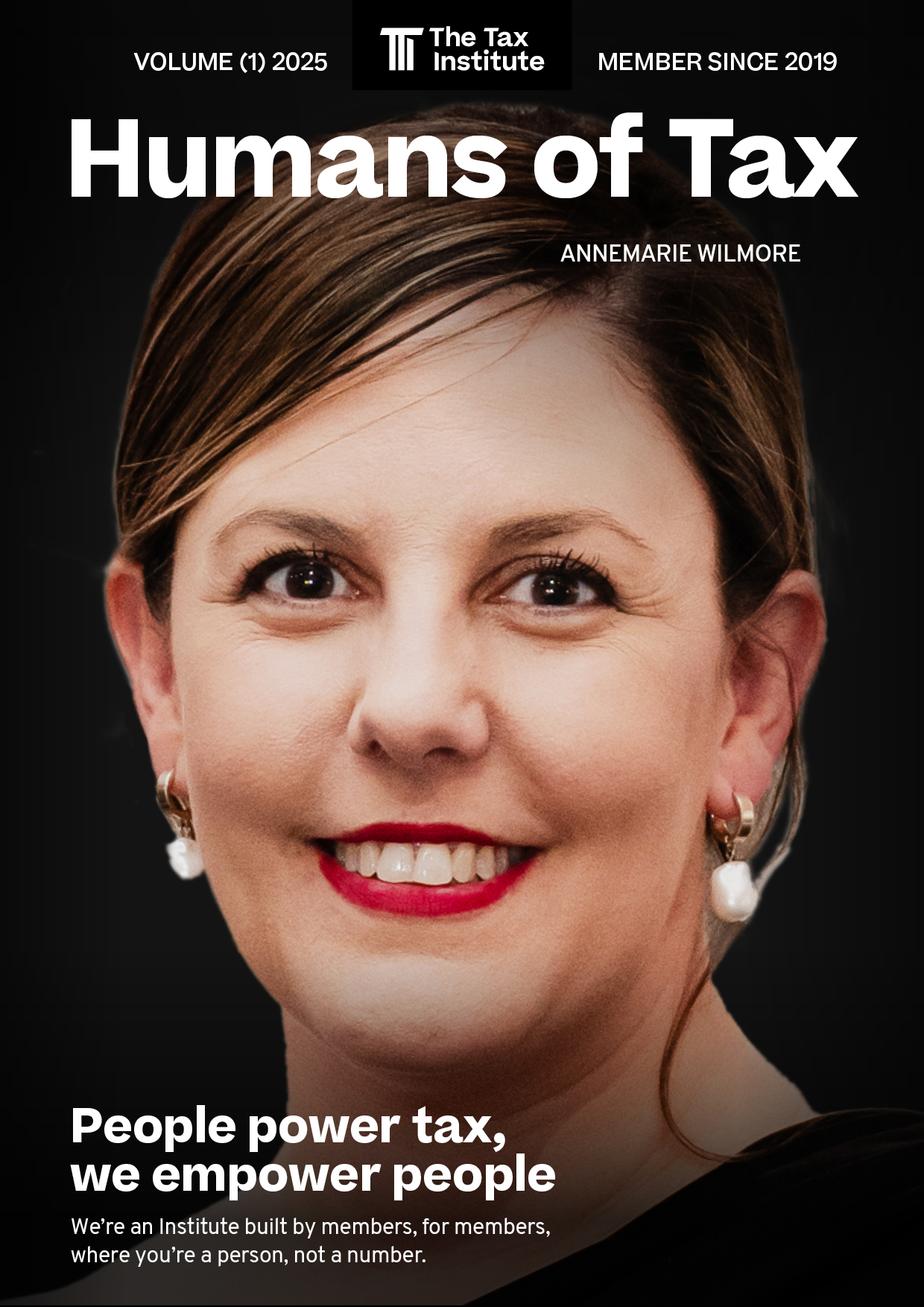
Annemarie Wilmore is a Partner at Johnson Winter Slattery, specialising in tax and revenue disputes, litigation and alternative dispute resolution. She’s been a member of the Institute since 2011.
In her own words, Annemarie shared with us how she uses her professional skills to support vulnerable women, how mentorship has helped her and how she’s paying it forward.
Annemarie, what are you passionate about?
At the moment, my passion project focuses on improving outcomes for vulnerable persons in their interactions with the tax system.
Recently I've been assisting domestic violence victim survivors in navigating the tax system in conjunction with the University of NSW Tax Clinic, led by Associate Professor, Dr Ann Kayis-Kumar.
My team and I have been assisting individuals in negotiating relief from tax liabilities that they didn't cause, but have fallen victim to, because they were under duress or under coercive control through their domestic relationships.
As part of the Tax Clinic Working Group*, I’ve also been advocating for holistic reform to the tax system to recognise a really important exception. Currently, the design of the tax system is such that it is predicated on a fundamental assumption that the information supplied to the Commissioner of Taxation which is used to form the basis of assessments and tax liabilities is inherently reliable. In addition, the tax system prioritises collection of tax debts, with very limited exceptions recognises. We think that in circumstances where domestic violence victims have been improperly made to bear the brunt of the liability, there are really good reasons for that policy assumption to be displaced, and for further exceptions to be recognised. Unfortunately the way the law works at the moment is that it doesn't recognise an exception based on coercive control or domestic violence.
Our recent work in advocating for holistic reform to the tax system has begun to gain momentum. We are hopeful that we can obtain the much-needed changes that we have been seeking to achieve in order to make the tax system fairer.
A lot of our recommendations have been taken up by Parliamentary Committees and the Inspector General of Taxation, which is exciting. We've started to get some really meaningful results and it's been really rewarding.
"We would like to see a tax system that supports, rather than unintentionally harm this group of financially vulnerable taxpayers."
That sounds like incredible work to be part of. Can you tell me a bit about how you got involved with it?
I’ve always wanted to help people. I remember being at university and doing… oh, I think it was called Tax Help back then. Basically, the ATO would train volunteers to help people who didn't know how to fill out a tax return. These are people that might have English as their second language or something like that.
I’ve always volunteered to some extent, but then the realities of life took over — mortgage, kids, those kinds of things. For some time I had wanted to help domestic violence victim survivors. I initially thought I'd have to wait and volunteer later in life when I had more time. Then I bumped into Ann at a Tax Institute event, and we got talking about her research and the Tax Clinic. It made me think that there may be a way to actually combine the two together. I started looking into the research that Ann was doing, and realised I could leverage off the skills that I use for corporate taxpayers — in terms of negotiating with the ATO and writing submissions and advocating — in this space. It's all the same skills, just applied in a pro bono capacity to these persons.
We’ve got an awesome pro bono program here at Johnson Winter Slattery, so that helps as well, to have the infrastructure as a firm to help these people and build it into what you do on a day-to-day basis.
That’s fantastic. What kinds of people are you seeing come through these programs for tax help?
Through the Tax Clinic it is domestic violence victim survivors who are typically from low socio-economic groups, so they can't otherwise afford a tax advisor. They’re people who might otherwise fall through the cracks of the tax system.
Some of these women have been made directors of companies and they had no idea. It's often their former spouse’s business, and in some cases, their financial identity has been fraudulently used. In other cases, the victim survivor might have known that they signed a document relating to the business, but they really had no idea about the implications of signing it. Usually, they have been coerced into signing documents – fearful of the abuse that might occur if they do not. These women are not involved in making financial decisions in relation to the business, but when you're a director of a company and you don't pay your tax bills, the ATO has a number of ways to recover tax debts, including making directors liable. Tax debts don’t typically have an expiration date. The debt remains owning until it is paid or otherwise released, or the individual becomes bankrupt. For the victim survivor’s we see through the Tax Clinic, they have on average a purported tax liability of over $100,000.
It must be such a scary thing for them to suddenly realise they have this huge tax liability that they had no idea about.
Well, not only is it scary, it's actually really devastating because they've been brave enough to leave a domestic violence or coercive control situation, only to be stuck with a tax liability that they were completely unaware of. It's obviously a very emotional, very traumatic period in their life.
When they're in that situation, they're typically quite isolated from family and friends and they may not be working because one of the ways that they're controlled is to not have any financial independence. So, they're completely reliant upon their spouse.
If they have fled their home, they're living in temporary accommodation and many of them are re-establishing their financial identity and starting to work for the first time, others are rejoining the workforce after a long time out of it.
Then, from the ATO’s point of view, the victim survivor might be seen as a better candidate to pay the tax liability, because they're working and earning an income, whereas the former spouse may not be in the tax system any longer. But for these women it's really devastating because if they can't pay the debt or if they can't go on a more flexible payment arrangement, they are faced with bankruptcy. That might mean they can't rent a place to live, they can't find work in certain professions, their ability to obtain a loan, it might impact their childcare arrangements and custody arrangements with their children.
It has this snowballing effect. By making them responsible for paying a debt that they didn't actually create, it may actually lead them to go back to that abusive situation because, as horrible as it was, it's a better world to be in than this world of bankruptcy, not having access to their kids and having nowhere to live.
We would like to see a tax system that supports, rather than unintentionally harm this group of financially vulnerable taxpayers.
That’s such a terrible situation to find yourself in.
It is. It's really horrible.
Which is why it's so rewarding to be able to use our professional skill set and knowledge in terms of navigating the tax system to help them.
The matters we have worked on have been dealing with quite substantial sums of money for those individuals, having regard to their situation. In one case, the director penalty notice was for $175,000. We prepared a detailed submission and engaged with the ATO, which had the result of waiving the liability entirely.
We had another one recently where the debt was $120,000, and while we didn't manage to convince the ATO to have the full amount remitted, the ATO did decide to reduce the liability by a substantial portion — nearly 80% — of the debt remitted.
It might not always be such a large sum of money to other people, but it can mean a lot to the victim survivor, at a crucial time in their life.
That’s incredible. What would be your advice to safeguard against being in this situation?
My number one piece of advice would be to try and preserve your financial independence. That could look different depending on your circumstances. It could just be having an income stream that's separate to your spouse or partner, or it could be keeping your finances completely separate. In other situations, you might decide to not assign your superannuation to your spouse or partner.
The other advice I have would be just to ask questions. By analogy, I know nothing about cars and I find every time I have to go to the mechanic I have to ask a lot of questions — not of the mechanic necessarily, but of trusted people that can explain things to me in a way that I can understand. Apply that same thinking to financial matters and tax affairs and get independent advice before you sign things.
"I remember sitting down with two of my male partners ... saying
'you need to find me a female partner that I can speak to about this.
How can it be that there are no role models?'"
Does hearing these stories take an emotional toll on you as well?
I think it definitely did when I was earlier in my career. As a younger advisor, you tend to take on some of the emotional troubles of your client. I think that's natural.
There comes a point in time, you almost don't realise it, but you kind of learn how to separate from that and develop your own professional skills in maintaining that distance.
That’s probably something that goes for other clients as well?
Yes, there can an emotional toll for corporates as well. My main role is helping corporate manage tax disputes and the person that is typically instructing me is the one who put in motion the transaction that is being reviewed.
So, there's a lot riding on the outcome of the tax dispute for them. It's emotional on a different level, but there's still a need to be really conscious of those sensitivities and that everyone is now scrutinising decisions that were made under their watch.
You don't necessarily think of tax as emotional, but it is, isn’t it?
It is!
Let's switch gears a little bit. Tell me about your experience with mentors in your career?
I've had lots of mentors at different stages of my career. You take something from all of them and make a sort of a patchwork quilt of all those experiences into your own experience.
When I was earlier on in my career a lot of my mentors were senior tax partners that I worked with on a day to day basis. There was a degree of rigour around tax training and sharing of knowledge. They would take the time to explain the policy intent for a particular set of provisions, or the context of how a section was brought about. That insight was incredibly valuable.
Then there’s on-the-job mentoring that's a bit more experiential. It’s having conversations focused on, “this is what I think the client is looking for” or “this is the way I think we should play this” or asking “how did you know to do it in that way?”
Now I try and do that for my team and explain where I'm coming from, what I recall about the policy intent at the time provisions were introduced, or an influential case that might have been a precursor to a change in the law. I certainly benefited a lot from mentoring , so I like to pay it forward where I can.
I'm curious if, as a woman in what is still a fairly male-dominated profession, you find that you gravitated towards female mentors?
Great question. I felt like I didn't necessarily have strong female mentors in the early part of my career. I also had children quite early in my career, and I struggled to find examples of women that were in professional services that had children and had come back to professional services. A lot of them had gone in-house or had gone to government roles.
Of course this was almost 17 years ago, and I feel the profession has changed quite a bit in this regard- for the better.
I remember sitting down with two of my male partners at the time, who I'd worked closely with, and saying “you need to find me a female partner that I can speak to about this. How can it be that there are no role models?”
And to their credit they did.
Then in my next role, I worked for four female partners and gained valuable learnings from all of them. Some of which I still put into practice today.
Oh! What a change!
Yes! I think it's really helpful for young women to see examples of role models that look like them and approach problems like them. Women sometimes approach problems and questions and interactions completely differently to men.
But I think on balance, it's important to be recognised for your contribution to the work that you're doing, irrespective of gender. I think that's the most important thing. If there's a great contribution that you're making, then all the other noise around gender drops away.
*UNSW Tax Clinic Working Group includes Associate Professor Dr Ann Kayis-Kumar, Professor Michael Walpole (co-founder), Kevin O’Rourke OAM (Adjunct Professor), Professor of Practice Jennier Granger, Tony Martins (Clinic Supervisor), Helen Lam (Clinic Supervisor), Jonathan Dorse (Clinic Supervisor), Professor Jan Breckenridge (Head of School, School of Social Sciences, Co-Convenor, UNSW Gendered Violence Research Network), Professor Debi Ashenden (Director, UNSW Institute for Cyber Security), Rhiannon Parker (UNSW Centre for Social Impact), Jasmine Opdam (Financial Abuse Service NSW, Redfern Legal Centre), Annemarie Wilmore, Partner Johnson Winter Slattery and Gina Iskander, Senior Associate, Johnson Winter Slattery.
Frank Crawley: half a century of helping clients
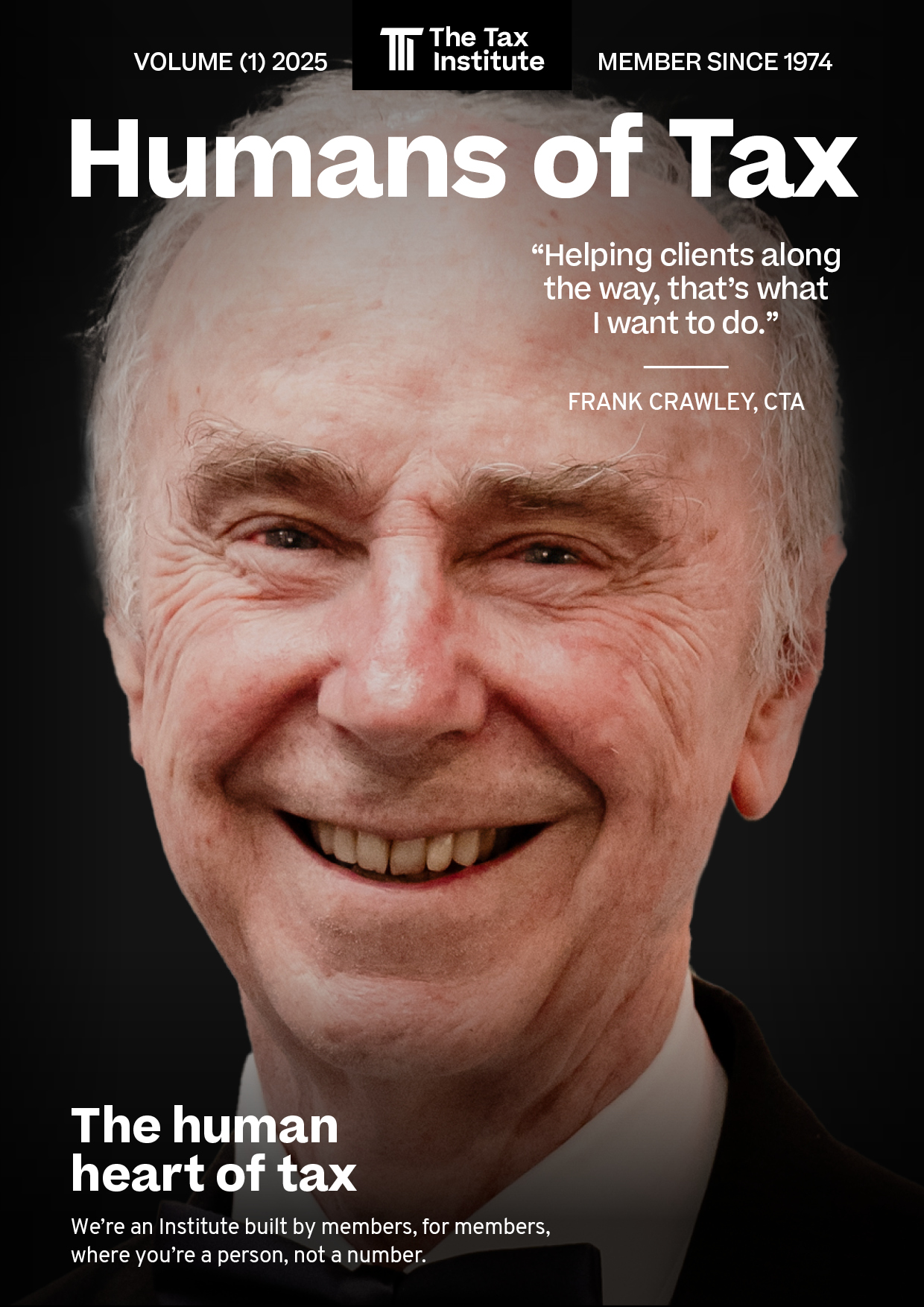
Frank Crawley, OAM, is Director of DF Crawley Corporate Services, Financial Director of the Order of Australia Association and has been a friend and member of the Institute for 51 years.
In his own words, Frank discussed with us his experiences over half a century in the tax profession, the ethics of client advice and the very valuable role tax professionals play in supporting key community services and organisations.
TTI: So, Frank, lovely to chat with you today.
Frank: Thank you very much for having me here.
Frank, you have been a member with the Tax Institute for 50 years, which is incredible. Can you take me back to where it all began? How did you get into tax and then what made you join the Tax Institute?
Well, let me answer the last question first. Why the Tax Institute? If I go back to when I did join, it was a time when both the legal and the accounting profession were actively involved with the topic of taxation. The Tax Institute was the only organisation at that stage that had a combination of both professions as members.
If you were a Chartered Accountant, you went to the Chartered Accountant Institute’s various functions, which dealt a lot with audit and not a great deal with tax matters.
The tax profession really needed input--- from the legal profession as to how they would interpret various things. The Tax Institute was the only one at that stage that combined legal and accounting.
Back in those days, membership was predominantly accounting. These days, I think it's about 50/50 legal and accounting. So that's the reason I joined.
When did it happen? It happened when I was discharged from the Army. I was a conscript for the Army, and when discharged, I then became very much involved in tax accounting.
"I’ve enjoyed tax because it was because it was advising on various changing elements of accounting and tax."
I bet, quite different.
But then progressively, I've stayed very much in tax and accounting all my life.
And what is it that you love about tax and accounting? What has kept you in the profession?
I don't really know the answer. --- Tax was very interesting. It wasn't necessarily black and white. It was a judgement as to what you were doing. You had to interpret what was going on. You had to provide advice on issues that were changing in the world. For example, franking credits, when they came in, it was something that was not common to the people that were investing in shares. So, the tax implications of that were very important at that time. It's now accepted as being normal, particularly in superannuation funds.
But I’ve enjoyed tax because it was because it was advising on various changing elements of accounting and tax. They both went together.
You’ve clearly seen a lot of change during your career. What would you like to see change in the future of the tax profession?
One of the things I'd like to see, which I don't think is going to come, is a lot less bureaucracy involved.
We have, particularly in the small business area, had a huge amount of administration purely to make things work for the small business. I can't see it changing, but I would really like it to change. I'd like it to be much easier for the small business to be able to get along with making profits and doing things, rather than having to deal with all the bureaucracy that's coming out of Canberra.
"Yes, it's quite easy. Your clients are the people that you've got to help, getting paid is secondary."
In such a long career where you've seen so much, what would you say is your proudest moment as a tax professional?
Helping clients. I can't pick one, but helping clients along the way, that's what I want to do. That's what I've always felt enjoyment out of.
I think that there is certain ethics that you don't go beyond. That's very clear. When I started out, there was never any need to have a whole lot of ethical education. It was what you did with your profession. That has definitely changed.
In my beginning days, I never felt that I had to worry about ethics. It just went with the territory. It's what you were as a professional person, assisting clients. That, to a certain extent, has changed in my 50 years.
That’s interesting. On that note, what’s the best piece of career advice you've been given that has carried you through that career of 50 years, if you can think of it?
Yes, it's quite easy. Your clients are the people that you've got to help, getting paid is secondary.
I love that. Now, you were awarded the Order of Australia in 2013 for your service to the community of WA. Can you tell me, what does community service mean to you and why is it so important that we're engaged in that kind of work?
The community service I was involved in, one was youth suicide and another was what was then called the WA Society for Crippled Children, another was a girls’ school and then another community.
I've always done this as part of my professional career. When you're an accountant, you find that every organisation needs somebody to help with the finances. I was asked to help in those various areas, and I was able to help quite substantially with financial guidance.
Particularly the organisation dealing with youth suicide. With my financial background and knowledge I was able to help them.
That was why I was awarded the Order of Australia. I'm still doing those things.
So, you've been a member for 50 years. Can you tell me a bit about how membership has helped your career during those 50 years?
Definitely the technical sessions that I attend and the ability to see and talk to people that are in the same profession, with the same problems, the same questions. That has been without a doubt the biggest assistance.
And knowing people in your community as well. Bruce Blackall, who's a WA accountant, and Robert O'Connor, a lawyer from WA, both of whom I know very well, are both Life members of the Institute. So that's how the Institute has been a big help to me.
Lovely, thank you so much. Thank you for speaking with me today.
It's been a pleasure and thank you so much and I wish you all the best and the Institute the best.
Sandra Farhat: ensuring compliance and cutting through complexity
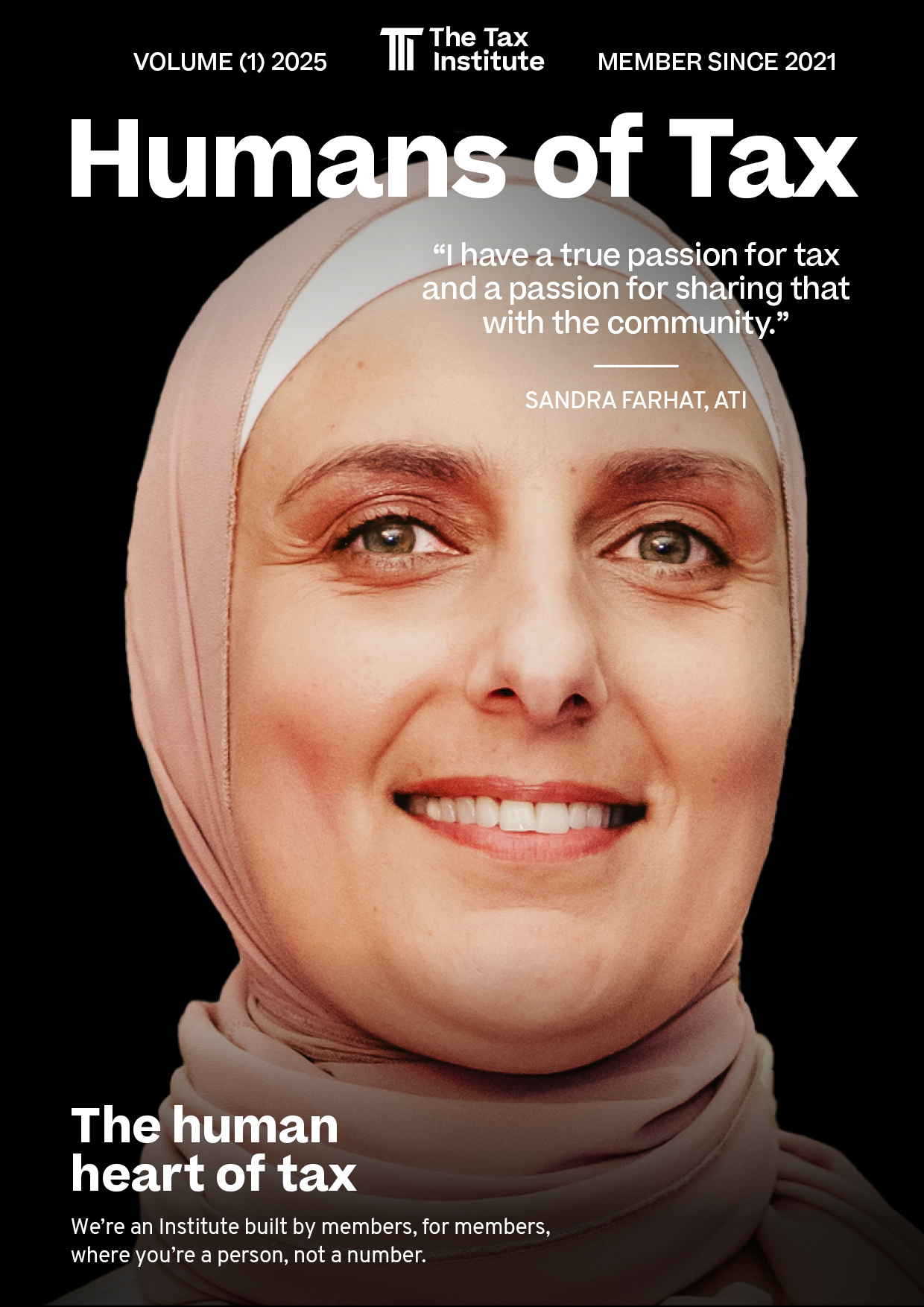
Sandra Farhat, FTI, is a Partner in the Tax Controversy and Policy group at EY, following a 20-year career at the Australian Taxation Office. Sandra has been a member of the Institute since 2021.
In her own words, Sandra let us into the world of the ATO during the COVID-19 pandemic, her thoughts around complexity and client relationships, and what it means to work in a globalised world of tax.
Let’s start at the beginning: how did you get started in tax?
I joined the Australian Tax Office as a graduate a long time ago. I wouldn't say that I was always passionate about tax. Coming out of uni, I'd finished a law degree and was quite interested in making sure that I could put that to really good use. I knew the ATO had a great graduate program and it was one that I applied to.
The rest is history, as they say.
So, you weren't necessarily passionate about tax at first. When you were younger what did you think you were going to be when you grow up?
I thought I was going to be a teacher. At some point I went from wanting to be a teacher to thinking, no, I really do enjoy legal studies, I enjoy working with the law and legal frameworks.
I wouldn't say I was ever invested in a particular part of the law. I just knew that I wanted to help people navigate a complex legal framework. My dream wasn't to be a tax lawyer, even when I started at the tax office. I won't say that I felt, “this is it, I'll be doing tax for the rest of my life”.
But I very quickly realised that tax and the Australian tax legal system is a critical part of our society. It's something that's quite important. Realising that a couple of years into my professional career gave me a greater appreciation of the space I was working in as a tax professional.
"I’m privileged to be able to say that I contributed
to what our government felt would be their key economic
response to this once in a lifetime event."
And eventually, you became an Assistant Commissioner at the ATO. During that time, you led the delivery of the JobKeeper compliance program.
Yes, that was one of the final things I did at the ATO. That was a big high to leave on.
You touched on how important the tax system is, and I feel like that's never been clearer than when we were getting through COVID and implementing JobKeeper and all the other stimulus measures. So, can you tell me a bit about that experience for you from within the ATO?
When COVID hit, before the government started to roll out stimulus, you could tell that the pandemic itself was going to be a once in a lifetime event.
Our initial reaction at the ATO was to look after our people – to make sure that we were dealing with this life-changing event in a way that was quite supportive of our people and our clients.
In addition to that, we also had to pivot and be agile in an incredibly quick timeframe once government had entrusted the ATO to deliver these stimulus measures. That is a level of trust that government put into the ATO, trusting us enough to deliver on these absolutely critical measures for our society, in terms of both the economy but also in terms of people's livelihoods really.
Being involved in the delivery of that personally was a privilege. I’m privileged to be able to say that I contributed to what our government felt would be their key economic response to this once in a lifetime event. I was personally proud, but also feeling the weight of having something so important that we were delivering on behalf of government as well.
I know that our members and tax practitioners generally were very much feeling the weight of advising clients through that time and helping them understand the stimulus measures. You were on the other side, delivering the measures and guidance to tax practitioners. How did you navigate that and keep your head above water?
Yeah, it was probably one of the most difficult times of my professional career.
One of the key factors that I think made it successful on the part of the ATO was the way people within the ATO were able to come together to deliver the measures. Everyone was all-in on the delivery of it. Having that level of support around us, I think, that was part of what made it even remotely possible.
There was an element of resilience for the key people that were involved in the delivery of the measures, but knowing that ultimately we had the support of everyone to do so really helped.
It's one of those things that, when you're in the thick of delivering it, you don’t always realise just how challenging and all-consuming it is going to be. You’re just forging on, reaching out for help when needed – which was always available – and just working your way through it.
Just getting on with it.
Yes. Once you’re in it you can't go backwards, so it's like, “alright, we just need to get this done.”
The other key challenge that we had was that the ATO is an administrator whose primary responsibility is to collect revenue. This was a measure whereby we were giving stimulus to eligible organisations. So, we were trying to achieve a balance between delivering this measure in an efficient, effective, easy-to-comply way, while making sure that we were maintaining the integrity of the measure and having a robust compliance approach to ensure that people weren't taking advantage.
There was real nuance and balance to how we tried to make it as easy to comply as possible so we could deliver needed support, but make sure that we weren't taking our eye off integrity and compliance.
In your current role at EY, you assist clients with managing ATO interactions and disputes. Tell me a bit about your approach to working with clients?
I view my role, really, as a trusted advisor to clients. I'm there to give them information, to impart knowledge to them, to help them deal with risk on their end and manage their stakeholders.
My role is to be as transparent with clients as possible as well, so they can make informed decisions and so that they understand the system with which they're dealing.
So, I don't have hidden agendas. I don't have a particular line. My approach really is to say, “here's the full spectrum of the particular issue. Here's everything that we know about it, here are your options. Now let's have a discussion about how we can help.”
It really is about making sure clients and their stakeholders understand this complex system that they find themselves in.
"The more you bring in different perspectives and out-of-the-box thinking, the more likely you are to have multiple different perspectives of an issue or a problem or a solution."
To change gears a little, we are living in an increasingly globalised world, with things like the rise of the digital economy and with people being able to work remotely more and more. How do you think that globalisation affects tax and how we work in the tax profession?
There’s probably a couple of different facets to that.
The first relates to the tax system itself and understanding that government policy around taxation is going to be heavily influenced by the global environment that we find ourselves in.
It would be a mistake to assume that tax policy is solely a domestic issue. There’s nuance, in that tax policy itself is impacted by global events and what other countries do, for example, we've seen that in tariffs most recently.
There’s also an administration aspect. The ATO is a world leading tax administrator and it looks to what other tax administrators do, it engages with its counterparts globally through many forums. Each country is learning from what other jurisdictions are doing, whether that’s on a best practise level or an issue level.
So, not only is there sharing of information, but there is ongoing collaboration between tax authorities that means globalisation also impacts on how the administrator approaches the tax system. We are seeing a greater connectivity globally between tax administrators.
We’re seeing the impact even from a people perspective. At EY we have a pretty sophisticated global connectivity. That means we often have people that come work in Australia, who've worked in other jurisdictions, or people from Australia going to work in other jurisdictions. Working for a global firm in a globalised economy adds a different nuance to how your people agenda can be delivered within the organisation.
We talk a lot about the idea of diversity in tax and how important it is to have people from all different walks of life contributing to the conversation. And it sounds like globalisation might be contributing to that. What are your thoughts on that?
I mean, the need for diversity is one of those things that is a given, though it can be a very complex thing when we try to achieve true diversity. We should always strive to bring diversity to any problem or issue or matter, whether that’s diversity of thought, diversity of gender, diversity of life experience or so on.
The more you bring in different perspectives and out-of-the-box thinking, the more likely you are to have multiple different perspectives of an issue or a problem or a solution. It avoids group think, it avoids everyone just agreeing with the loudest voice.
Tax as a professional industry has historically not always been incredibly diverse. But when you look at junior ranks coming through now, it's extraordinarily diverse. So, I think it'll be a very exciting time in the tax profession as we see those people come through the ranks.
We are seeing it happen now actually, and not just in the junior ranks, but even in senior ranks. A lot of my clients have Heads of Tax who are female, culturally diverse or both. So, I think we are seeing a significant shift in the demographics of our industry.
Final question and it’s an important one: you were obviously very busy during COVID at the ATO, but did you take up a COVID hobby to de-stress?
It was really just walking. Nothing fancy like pickle ball or golf or knitting.
It was an extremely busy time and I found that given the enhancements in technology, that there were lots of calls I could do just walking – like this one! You know, you don't always have to be on camera. If technology did anything, it was not just create flexibility in hybrid working, but it also gave me more time to be able to just get out there within my 5-kilometre zone doing some walking.
And there's one other thing I learned during COVID: my childhood desire to be a teacher was definitely rubbished when I realised how difficult home schooling was.
Glad you went into tax instead then?
Absolutely. That was my lesson.
Tim Sandow: connection, communication and chicken coops
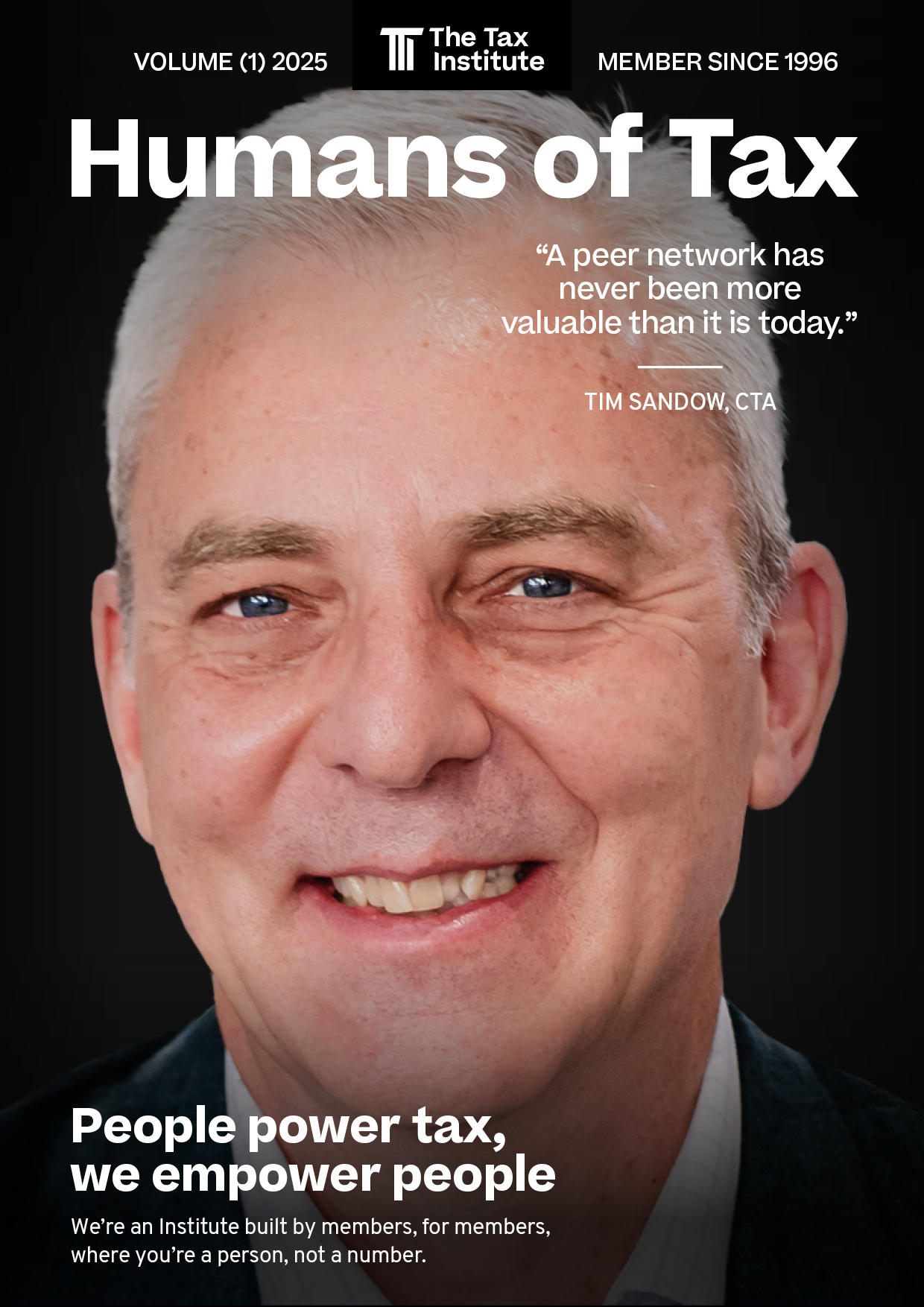
Tim Sandow, CTA, is the 2025 President of The Tax Institute, Partner, Corporate & International Tax at BDO and a part-time chicken farmer.
In his own words, Tim shares his story with the Institute and the vital role of connection and community.
From client work to building a reputation, communication is key
To me, the difference between a good tax professional and a great one is: a good tax professional is smart. A great tax professional understands why the law works in the way it does and they can explain it to their clients. It's that communication piece and the ability to speak to people in a way that connects.
About 25 years ago, I was asked whether I'd like to join the national tax training group for the firm that I was working in, and it was a golden time in tax reform. The GST was about to be introduced in time for the Sydney Olympics, the thin capitalisation rules were being completely changed and tax consolidations was introduced. It was an absolutely amazing time to be a tax professional.
I was in my late 20s. I was probably a little bit cocky and I thought I knew everything there is to know about tax. So as I started getting into the role and I was doing some training, the partner who I was reporting to took me aside one day and gave me some advice. He said “Tim, presenting a great training session is not about showing how smart you are. It's about whether the person you're talking to understands what you're saying.”
And I reflected on that afterwards and I thought, that's actually really, really important. It's not about me. It’s about the other person. I take that into the client work that I do even now. If my client doesn't understand what I'm talking about, that’s a failure on my part.
"... that peer network has never been
more valuable than it is today."
It’s true of being invited to speak at an Institute event as well. When you’re asked to speak at a function or an event, it’s not just because you’re smart or experienced in a topic. You’re asked to speak because you can connect to your peers, take them on the journey with you, and so they want to hear more from you.
Chicken coops, Donald Trump and open doors for advocacy
I live in the Adeliade Hills with my family and a flock of chickens. Before I began my term as President, I spent part of my holiday break building a mobile chicken coop, that we could take around our place and have the chickens do all the hard work in the garden for us. While I was building it, I had time to reflect on what I wanted to do with this leadership opportunity and how I could give back to my fellow members in that capacity.
Even then, I knew 2025 would be an interesting year in the world of tax. We've got a Federal Election here in Australia. We've got Donald Trump as President of the US and introducing additional tariffs and the global impact of tax policy in the US. It's a turbulent time in many ways, but it’s also an opportunity for the tax community to speak up about issues that affect our tax system – to lay it all out on the table and have that open conversation about how we move forward.
For me, authentic leadership means giving the people you represent a voice in that conversation. We can achieve a lot more as a collective member voice than just one individual voice. That’s why I’m passionate about really working with our members to understand what matters to them. What are the problems we’re facing and what solutions will make a genuine impact?
"What I’ve found is that we achieve a lot more
by being constructive and practical than we do by
necessarily making a lot of noise."
One of the challenges we're currently grappling with is a long list of announced but unenacted tax measures creating uncertainty in how the tax law applies. Having certainty in the advice that we're giving to our clients is really, really critical. Because how can you sit with a client and have a meaningful conversation about their situation, if you’re uncertain of what tax legislation will look like in twelve- or eighteen-months’ time?
It’s those practical, constructive and member-led conversations and outcomes that I’m really passionate about exploring.
A really great example of amplifying our members’ voices in a real way is the work we did with the Assistant Treasurer and the Tax Practitioners Board on the changes that were made to the Tax Agent Services Act last year.
We knew these measures were coming in, but we wanted to make them practical and fit for purpose for our members. So, we were able to work behind the scenes to come up with some really practical and pragmatic ways to try and make sure that they were having the right impact, at the right level, for our members.
What I’ve found is that we achieve a lot more by being constructive and practical than we do by necessarily making a lot of noise. We approach issues from a standpoint of genuinely wanting a fair outcome and representing the real and reasonable concerns of practitioners. The result is that that door is open for us to continue to advocate on issues in the future.
The key to success: real community connection
Your career is not a straight line. It will go off at tangents at any time when you least expect it. And so, it's about grabbing opportunities as they come along. There’s an amazing amount of resources available through The Tax Institute – take advantage of them.
If I reflect back on my career one of the best moves I made was getting involved with The Tax Institute, because it gives you access to insights from seasoned professionals that you don't read in a textbook and you don't read in legislation and you don't read in rulings. You deepen your expertise and you make such valuable connections.
Some people say, “oh, but I'm just talking to my peers and they're my competitors.” But that peer network has never been more valuable than it is today. Particularly all the uncertainty in the profession at the moment, being able to bounce an idea around with somebody in the same boat, and say, “hey, what do you think?”, that's just gold. And the only way you get that is by building real relationships.
That’s what I love about the Tax Institute’s community. There’s very little ego. You’ll rarely hear members worrying about giving away their IP, their expertise or their time. Instead, we all support each other. That kind of community spirit has never been more relevant than now.