
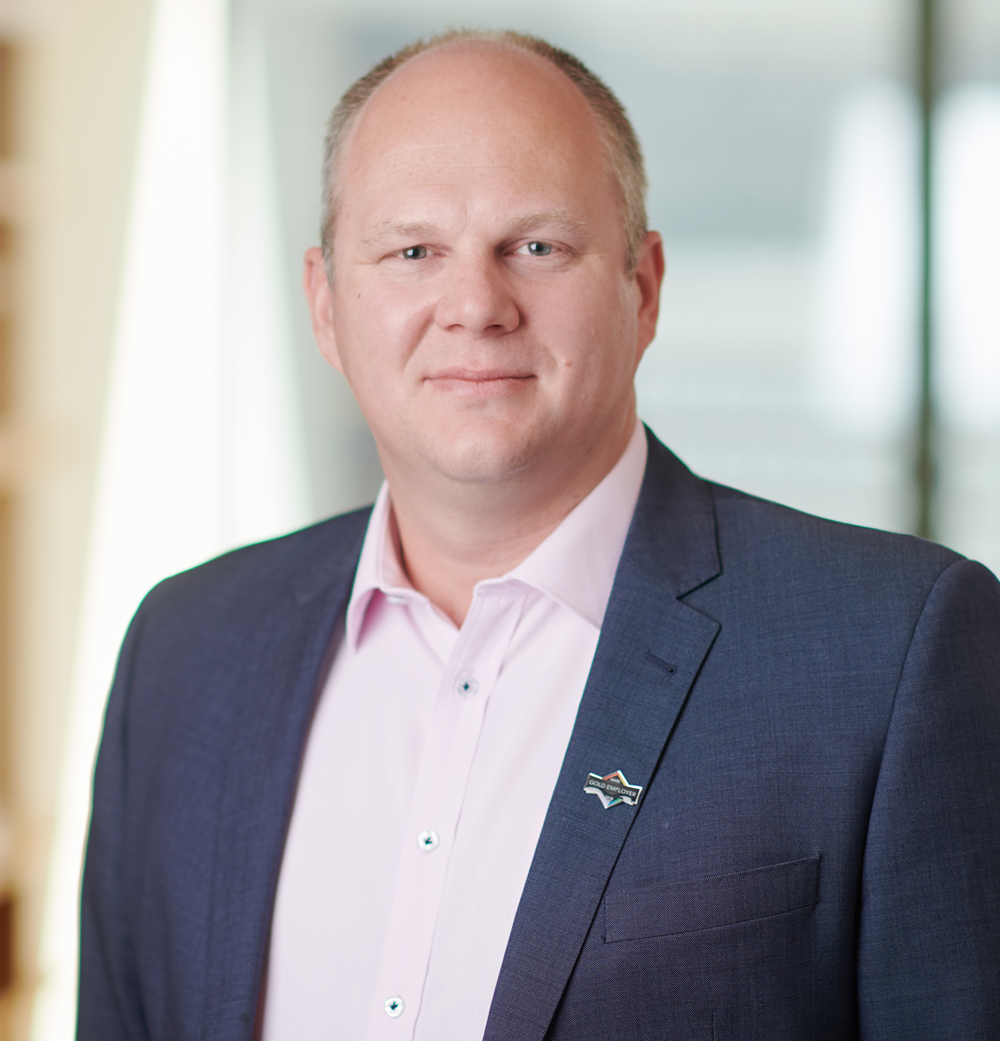
For more than 25 years, Bastian Gasser has built a career in GST advisory, driven by a love of problem-solving and an enduring curiosity about tax. What began as a chance decision during a vacation program has evolved into a specialist career spanning PwC and MinterEllison, where he now leads one of Australia's leading GST practices. He shares how he found tax, why he remains passionate about advocacy, and what keeps him excited about the future of GST.
Can you tell us a little about yourself and your career journey so far?
I started in tax 26 years ago. I'd done a number of different university degrees and didn't really know what I wanted to do. A friend convinced me to apply for vacation clerkships at the Big Four accounting firms, and he was right.
I ended up doing a vacation program at PwC. The choices after I interviewed were tax, audit or assurance, and tax was a really easy choice when those were the alternatives.
With no real intentional planning, I spent a few weeks in the tax group and, in particular, the GST group. That was serendipity too. After my interview, they called and asked which tax group I was interested in. They listed eight groups, and GST was the last one they mentioned, so I picked the last one. That decision 26 years ago led to an entire career in GST advisory.
I loved the work, joined PwC as a graduate the following year, and quickly realised it was an area I was interested in and good at. Later, I completed a law degree while working because most of the people around me had a law background. Once I finished, I moved to MinterEllison, where I've now been for more than 20 years.
What did you find most surprising about tax when you first started?
I had no idea it existed as a career to this extent.
My conception of tax was someone doing your tax return. The idea that you could make a career out of tax law or tax advisory wasn't something anyone in my family did, and even at university I didn't know it was really a career option.
Once I saw what it was like being in an advisory group of well-trained professionals working with clients to solve complex problems, it suited me perfectly. I felt at home very quickly and I still do.
Part of what I see as my role now is making sure the next generation of students aren't as ignorant as I was about their options. I spend a lot of time encouraging law clerks and graduates to give tax a go because many of them discover they love it once they're exposed to it.
What has been the biggest change you've witnessed in tax throughout your career?
The biggest change has been the talent pipeline.
When I started, I was part of a huge graduate cohort. We had six graduates doing GST alone at PwC Melbourne and probably 30 or 40 people joining tax more broadly.
Those numbers have fallen dramatically over the last 10 to 15 years. The number of graduates entering tax through accounting firms and law firms has reduced significantly, which has had a major impact on the pipeline of talent available to the profession.
We've moved from a model where there was always a cohort coming through behind you to a situation where experienced GST advisers can be very difficult to find in the market.
What prompted you to become involved with The Tax Institute?
When I moved to MinterEllison, I went from being part of a very large GST team to effectively being in a team of two in Melbourne.
I lost that peer support and the natural training that comes from being surrounded by lots of GST specialists. Joining the GST Technical Committee became a way to stay connected to the broader GST ecosystem.
It gave me access to other advisers, information about potential law reform, ATO developments and opportunities to contribute to submissions. It became a way of staying connected while I was building a GST practice at MinterEllison.
What made you want to volunteer and join the GST Committee?
Mainly to get that connection.
One of the things I valued was finding out about proposed law changes and ATO guidance and having the opportunity to discuss those issues with colleagues and contribute to submissions.
It shifted my focus from simply advising clients on what the law is today to having a deeper understanding of where things might be heading and what issues the ATO is paying attention to. That access to information made me a better GST adviser.
What do you enjoy most about being involved with The Tax Institute?
When it works best, it's a great way to foster discussion between professionals.
When the ATO releases guidance that we think is problematic, it's reassuring to hear that it's not just your view. We can discuss it, exchange perspectives and work out whether there's an opportunity to provide feedback that improves the outcome.
The other benefit is the diversity of views around the table. Committee members come from private practice, industry and sometimes former ATO backgrounds. Hearing those perspectives makes me a better GST practitioner because it broadens my understanding of the issues.
If you weren't a tax professional, what career do you think you might have pursued?
Probably medicine.
I started and didn't finish a lot of degrees at university, and medicine was probably the one I spent the most time studying. I could well have been a doctor.
There's probably some overlap there because both professions involve problem-solving. In hindsight, though, I'm much better at problem-solving with the written word than I am with blood and gore, so I think I made the right choice.
What do you enjoy when you're not working?
For me it's really about balance.
I have two young children, so family is a big part of life. Particularly since COVID, I've played a much bigger role in their lives by working from home more and being involved in their schooling and activities.
I also enjoy skiing and take the kids skiing whenever I can. Beyond that, it's the usual mix of hobbies, exercise and trying to maintain some balance, although work still takes up a fair chunk of my life.
Do you have any hidden talents?
I always enjoyed finding shortcuts for tasks that took a long time when done the traditional way.
When digital data rooms and technology-driven due diligence processes started emerging, I became quite involved in those projects. Looking back, it was fascinating to be part of the early stages of digital products that are now commonplace across the profession.
What advice would you give the next generation of tax professionals?
You've got to enjoy the basics of being a tax adviser, which is really about problem-solving.
It's taking a different set of facts every time and applying legislation, case law and ATO guidance to find the right answer.
I encourage junior tax professionals to draw lots of diagrams and make sure they fully understand the facts before jumping to the legislation. Once you understand the transaction and all the parties involved, the technical analysis usually becomes much easier.
It's very easy to focus on a particular provision before you've properly understood the factual background, and that's where mistakes happen.
What excites you most about the future of tax?
As a GST practitioner, I'm actually looking forward to the first time the government chooses to make a substantive change to the GST Act.
It's been 26 years, and we still haven't really changed the rate or the base. The first major change will be a seismic event for GST advisers because we've never experienced it before.
Most other taxes change regularly, but GST has remained remarkably stable. When significant reform eventually arrives, the challenge won't just be solving technical questions. It will be helping clients prepare for and adapt to legislative change.
Are you passionate about the advocacy work you do through The Tax Institute?
Yes, although it can sometimes be dispiriting when law reform doesn't happen.
Every few years we give it a good go because I think advocacy is an important part of being a practitioner. We spend a lot of time engaging with the ATO because that's often where you can make a practical difference.
The Tax Institute has a great relationship with the ATO. Through my role as Chair of the GST Committee, I sit on the GST Stewardship Group, which is one of the most useful channels for information flowing in both directions between practitioners and the ATO.
It gives us an opportunity to provide feedback and allows the ATO to understand how its guidance is landing with industry and advisers. I think that makes both organisations better at what they do.
What advice would you give tax professionals who are considering volunteering?
It's important to remember that the work doesn't fall on one person's shoulders.
The committees are intentionally large, which means contributions can be shared among people who have both the interest and the availability at a particular time.
There are many ways to contribute that don't involve writing a 60-page submission. Some of the most valuable engagement is simply being in the room, listening, sharing your perspective and helping shape discussions.
The committees also provide members with a voice. A good example was when we surveyed members on food classification issues and used that feedback to help inform discussions with the ATO. It's a great conduit for members to influence how things are done.
What has been the most rewarding moment of your career so far?
Making partner.
When I joined MinterEllison, there wasn't really a GST practice in Melbourne and I was given the opportunity to help build one.
That was a daunting proposition for a 26-year-old, but with the support of the firm and through the skills I developed over time, I was able to build both a team and a practice.
After spending years figuring out what I wanted to do, reaching partnership was a great moment because it confirmed I'd found a career I genuinely wanted to build.
What is a skill you'd love to learn if you had the time?
I'll give a slightly geeky answer.
I'm a very specialised adviser. Within a law firm, I'm not just specialised in tax, I'm specialised in GST.
Sometimes I'd love to be that generalist tax adviser who can answer every question. I'd love to be a stamp duty specialist, an income tax specialist and everything else as well.
The reality is that tax has become so specialised that it's difficult to be an expert in every area. That's probably the downside of being a specialist. It's incredibly rewarding, but you won't always be the person who can solve every tax problem in a single phone call.