
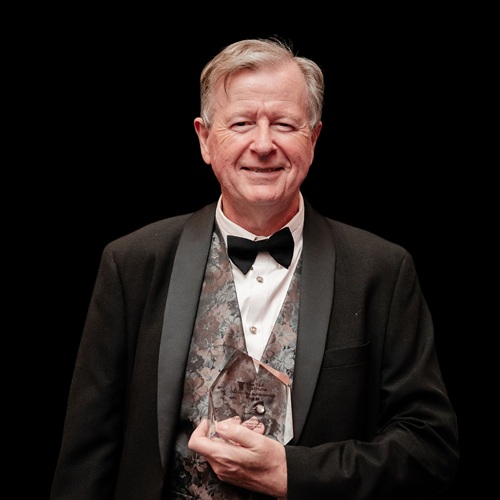
Bruce Collins is a Chartered Tax Adviser and founder of boutique tax law firm Tax Controversy Partners. After more than 35 years with the ATO, including senior executive roles across technical, compliance, dispute resolution and litigation functions, Bruce now assists individuals, small businesses and private groups with complex tax matters.
With a background in psychology, accounting and law, Bruce has always been fascinated by the people behind the profession. He is passionate about helping others, sharing knowledge with the next generation of tax professionals and improving the way the profession works together.
What first drew you to tax? Was it always the career path you imagined?
I ended up in tax by complete accident. I originally intended to become a neuropsychologist. I was studying at university in the 1980s and ran out of money, so I joined the public service to support myself while I worked out what I wanted to do next.
I was offered a range of departments and decided that tax was probably a better fit for me than working in social security. I thought I would spend a year there, recover financially and then return to my studies. Instead, I ended up studying accounting, then law, followed by a couple of Masters degrees in tax law and international tax.
That short sojourn at the ATO turned into a lifelong career in tax. I ended up spending thirty-five and a half years there.
It is interesting looking back because I originally studied psychology and philosophy, and many of those skills around understanding people and dealing with human behaviour have become very relevant in tax. Ultimately, tax is not just about rules and legislation. It is about how people interact with the system.
Your background in psychology is fascinating. Has it influenced your approach to tax?
Definitely. I was originally going to become a neuropsychologist, focusing on brain function and disorders. While I am not a practising psychologist, I probably apply a lot of those skills in my work.
A lot of what we deal with involves people who are having difficulties with the tax system. Many are vulnerable people who are experiencing significant stress or trauma. I am not counselling them, but understanding where they are coming from and helping them move forward despite their circumstances is an important part of what we do.
I spent decades as a senior manager in the ATO, so a lot of that experience involved managerial psychology as well. Whatever you think about the tax system, it is the way people interact with it that is important. That is where the rubber hits the road.
What has been one of the most rewarding moments of your career?
After almost 45 years, it is very difficult to identify a single moment. For me, the highlights have really been a series of interactions with people rather than one particular event.
I have had the privilege of working with very senior people in the profession, including Commissioners of Taxation who became mentors to me. I learned a great deal from watching how they approached problems, how they communicated and how they dealt with people.
One of the early highlights was writing a Commissioner’s speech for the first time. I went on to write many more, but that first opportunity was a memorable one.
However, the most rewarding moments have often been about helping people. I have dealt with people who were in incredibly difficult circumstances and where we were able to convince the ATO to change direction and exercise its discretion.
I remember working with people who were illiterate refugees facing multi-million-dollar tax liabilities because they had been taken advantage of by their bookkeeper. The money that should have gone to the ATO had gone elsewhere, and these individuals were facing the prospect of losing everything they had built since coming to Australia.
We were able to explain the circumstances to the ATO and, at the court steps when they were facing judgment debts and possible bankruptcy, we managed to convince the ATO to remit the director penalties.
Those outcomes saved those people millions of dollars and potentially saved them from losing everything they had worked for.
For me, it has always been more about the people side of things rather than a single big achievement. Helping people make a difference in their lives is what has been most rewarding.
What is something you believe about the profession now that you did not understand when you first started?
That is a really good question. I think the biggest thing I have learned is that everybody thinks they are not biased.
There is a thing called “bias bias”, which is where people recognise bias in others but do not recognise it in themselves. What I have realised over time is that everyone involved in the tax system has their own perspectives and experiences that influence how they see issues.
Tax practitioners have their own perspectives, and the ATO, being made up of individuals, also has its own perspectives. A lot of my role has involved navigating the difference between the taxpayer’s position and the Commissioner’s position.
What I have learned is that nobody is entirely right and nobody is entirely wrong. The reality is usually somewhere between the black and white view of the world. We live in shades of grey.
There is also a tendency for people to think they have a 100% chance of success in litigation because they believe they are right. But nobody has a 100 chance in litigation. We have seen that in recent High Court decisions where outcomes have surprised many people.
Once a matter reaches the judicial system, different perspectives are considered and unexpected outcomes can occur. The world is not a simple mechanical system.
Earlier in my career, I thought that if I could work out how people worked, I would be able to understand everything and influence everything positively. I now realise that all you can do is influence the part you play. You cannot control everything that happens.
What do you attribute your success to?
Other than being reasonably smart, I think the biggest factor has been being willing to work hard and work well with other people.
I think conscientiousness is one of the greatest indicators of success. If you are prepared to put effort into what you are doing and approach things properly, that will take you a long way.
However, I also think the ability to work well with others is an understated virtue.
I am not always the smartest person in the room, and I think recognising that is important. Other people often have better ideas than I do or bring different strengths to the table.
At a certain size, having a team of people working together is far more effective than trying to do everything yourself. Everyone has strengths and weaknesses. Someone might be excellent at strategic thinking but not as strong on detail, while another person may complement them by bringing those skills.
The best teams are those where people’s capabilities work together. Ultimately, I think success comes from being able to engage effectively with others and work together to achieve something worthwhile.
What part of the profession are you most passionate about?
One of the things I am most passionate about is sharing expertise and knowledge with people coming through the profession.
People did that for me. I had great mentors, including Commissioners of Taxation, senior people in the ATO, other professionals and academics who shared their knowledge and experience. Those people made me richer as an individual.
One of the challenges facing the profession is the ageing of the workforce and the loss of experience and knowledge about what has come before.
There is a saying that those who do not learn from history are doomed to repeat it. Part of our responsibility is sharing that history so people understand the context of where we are now and learn from the mistakes of the past.
At the same time, we need to recognise that the world is changing. Artificial intelligence and generative AI will change the way many things are done in the future.
The challenge is not just accessing information. It is understanding what that information means and how to apply it. That is something you learn through experience and practice.
How did you first become involved with The Tax Institute?
Firstly, I read the journals, because they've always been a fantastic repository of knowledge and the sharing of expertise by people. And one of the honours in my career actually is writing journal articles to be published in that suite of products.
When I was in the ATO, I kept getting into various roles where I was a representative of the ATO, so I was speaking as an ATO representative at Institute Events at various points. But I joined the Institute pretty much after I qualified as a lawyer. And it seemed like it was a good way to be connected to the profession.
So, back when I got my ticket, so to speak, I joined fairly soon after that.
How has your involvement with The Tax Institute influenced your career?
Certainly, it's given me an enormous network of people that I have dealt with over the years in various capacities, both when I was in the ATO and outside as a practitioner in private practice. The wealth of knowledge and experience, the sort of stuff I was talking about earlier that comes not just from me, but from other people, and the willingness that people have to share that experience with others and to improve the capability of the profession as a whole, I think is wonderful.
The Institute, I think, is a fantastic organisation, made up of people with goodwill who want to contribute to the whole integrity of the profession, the capability of the people within it, and the health of the system in which we operate. Because the advocacy work that the Institute does is exemplary. It is fantastic to be able to provide feedback to government, both on policy initiatives, both ones that are in contemplation and ones that should be thought about.
And also, to work with the ATO on the implementation of their strategies and to shape the practitioner's input into that, I think is incredibly important.
What is something people might be surprised to learn about you outside of work?
I'm an inveterate war gamer and role-playing game enthusiast. So, I've been doing that since the 70s. I've been running a Dungeons and Dragons group continuously since 1978.
I've still got people that were playing with me then that are playing with me now.
How do you find time for hobbies alongside your professional commitments?
One of the things about conscientiousness is that you need to organise your time and you need to budget for the luxuries, else work will swamp everything else. You need to build those luxuries in. You have to be sustainable.
So even though I work long hours and work at different points in the week (and weekend), I always try and make time to have some fun things. I suppose that all work and no play would otherwise make Bruce a dull boy.
If you were not working in tax, what do you think you would be doing?
Well, that's a really good question. I think I'd still be working with people. I do a bit of volunteering work in various forums and situations. So, I'd probably be volunteering somewhere to help people in a different context.
As it is, we do quite a bit of pro bono work in our practice. Some people who are very vulnerable need help and I think that if I wasn't working in tax I would be working in some capacity to assist in a volunteer organisation.
Would you say that you're driven by this need to help people?
I think that's probably one of my major motivators. The thing is that I like to help people and I like to get paid for it. the tax profession is a good place to do that.
For me, it's the people interaction. I'm relatively extroverted. So, I can function alone, but I prefer to actually be bouncing off other people and working with other people rather than working alone as a rule. I do some of my best work when I'm alone, but the point is that it's more fun (for me, at least) when you're actually interacting with other people.
What is a skill you would love to learn if you had all the time in the world?
I would love to play a musical instrument, but I have zero talent in doing so, as far as I can determine. Probably the guitar. Something else that people probably don't know about me: I'm a heavy metal music fan. I would love to be able to play electric guitar in a heavy metal band – where my (poor vocals would be covered by the mighty riffs ...
Who are some of your favorite heavy metal bands or guitarists?
I love Iron Maiden and Black Sabbath, in both incarnations of Black Sabbath. I think that guitarist-wise, I mean, Led Zeppelin is probably up there. It’d be hard to pick a particular guitarist in the metal sphere that I would pick, but I just love the interplay of words and music. I suppose that, if I could do one other thing, it would be to play a musical instrument.
What excites you most about the future of tax?
I think the opportunities of technology are probably the thing that is most interesting at the moment. People think that AI will revolutionise tax by doing all the dull things, but I think that in the leveraging of the ability that AI offers, it's the synergy between human beings in putting their bit into the AI sphere.
That will offer the greatest opportunities for the future. Talking with some of my colleagues, accountants, and lawyers, because I'm bilingual, I'm both an accountant and a lawyer. So, the point is that there are a lot of mundane accounting tasks and some legal research tasks that can be done best by machine.
But the point is that people need to be in the loop. The “human in the loop” thing is the secret for the future. If there is one thing that people need to focus on, and that it excites me, is actually how we can make AI work for us rather than us ending up being slaves to the machine.